Publications
For submission of articles or Working Papers to CEsA, please send an email to:
comunicacao@cesa.iseg.ulisboa.pt

Circuitos de Comercialização Informal de Produtos Agrícolas na Guiné-Bissau: Relatório de Análise
Abstract:
This book examines the informal circuits of agricultural product marketing in Guinea-Bissau, based on field research conducted across all regions of the country. Drawing on both quantitative and qualitative data, the study reveals the strategies, challenges, and operational logics adopted by vendors — particularly women — who ensure urban supply and the livelihood of thousands of families. Focusing on the female informal economy, it highlights practices of resistance, community solidarity, and exclusion. The book also offers recommendations for public policies that acknowledge and value this vital sector.
Cite this ebook:
Sangreman, C., & Vaz, J. (2025, agosto). Circuitos de comercialização informal de produtos agrícolas na Guiné-Bissau: Relatório de análise. Lisboa: CEsA/ISEG Research/ISEG. ISBN 978-989-54687-7-5

Mozambique, 50 years (1975–2025): Does the struggle continue?
Abstract:
This article revisits Samora Machel’s famous slogan ‘A luta continua’ (‘The struggle continues’) to analyse the 50 years of Mozambican independence (1975-2025). It argues that the initial anticolonial struggle has transformed into a series of protracted internal conflicts. Drawing on historical analysis and long-term ethnographic insight, the article traces a sequence of challenges: from FRELIMO’s postindependence turn to Marxism-Leninism and the devastating civil war with RENAMO, to the contemporary pressures of extractive capitalism and the recent jihadist insurgency in Cabo Delgado. The article analyses this latest conflict as a complex manifestation of local grievances articulated through a religious idiom. It concludes that in the face of these persistent crises and a flawed 2024 election, Machel’s revolutionary slogan now functions as a poignant interrogation of Mozambique’s unresolved contemporary dilemmas.
Cite this paper:
Macagno, L. (2025), Mozambique, 50 years (1975–2025): Does the struggle continue?. Anthropology Today, 41: 21-24. https://doi.org/10.1111/1467-8322.70006

Claude Meillassoux dans la Révolution Mozambicaine
Abstract:
This article stems from a project entitled “Sources for the History of Economic Anthropology: Claude Meillassoux in Mozambique”, which, between January and March 2023, was funded by the programme “Visiting Senior Professor Abroad” (Capes-Print-Ufpr – Capes 88887.757020/2022-00, Brazil). Several people and institutions collaborated in this research over its three-month duration. I am grateful to my French colleagues who, at one point or another in their careers, were close to Claude Meillassoux and provided me with valuable advice and information. My thanks go to Michel Cahen, Jacques Marchand, Antoine Bouillon, Ingolf Diener, Jean Copans, Michel Samuel, Jean-Loup Amselle and Christine Verschuur. Needless to say, any shortcomings in this article are my sole responsibility.
Cite this Paper:
Lorenzo Macagno, « Claude Meillassoux dans la révolution mozambicaine », L’Homme [En ligne], 253 | 2025, mis en ligne le 01 avril 2025, consulté le 18 août 2025. URL : http://journals.openedition.org/lhomme/51517 ; DOI : https://doi.org/10.4000/13olg

Mundo Crítico No 12: Desafios actuais do financiamento
Abstract:
Over the past few months, we have been witnessing profound changes in what is known as Development Aid. The reduction of ODA by several countries, including the USA and the United Kingdom, is opening up new scenarios at a time when a more multipolar world vision is emerging—one that increasingly favours a “blended growth” model, where diverse types of financing and approaches combine the public and private sectors. Another element to consider is the growing importance of large-scale philanthropic actors in Development Cooperation. The “Conversa Imperfeita” that opens this edition of “Mundo Crítico”, bringing together Ana Fernandes and Ndongo Samba Sylla, reflects on the tensions running through this new ODA context, highlighting longstanding structural issues while also attempting to outline the new challenges posed by this present moment and the near future.
In the same vein, the contributions in this edition reflect on the so-called ODA crisis from various perspectives, following the evolution of this mechanism and moving towards an outlook capable of engaging with the emerging world order, as well as the financial implications that come with it. Alongside these more analytical texts, we have chosen to publish the Portuguese versions of pieces that point towards concrete proposals aimed at a fairer reform of resource allocation, and consequently, the distribution of wealth. To help foster alternative thinking, we also offer a reflection on the Participatory Budget in Uzbekistan, as a case study in development financing through public participation.
The “Modos de Ver” section features part of a report on the international e-waste trade, carried out in Ghana by journalists Paula Borges and Djibril Mandjam, the result of a journalism grant from an ACEP initiative in partnership with Eurodad. The same issue is at the heart of one of the “Narrativas”, while another provides an insider’s account of the drastic funding cuts from USAID.
The theme of the “Ecos Gráficos” section is the exploitation of creative labour. This edition concludes with a review of Carlos Lopes’s book The Self-Deception Trap.
Cite this Journal:
ACEP & CEsA (2025). “Desafios actuais do financiamento”. ISEG/CEsA – Centro de Estudos sobre África e Desenvolvimento. Revista Mundo Crítico nº 12 (Jul 2025). ISSN 2184-1926

A Framework on Eudaimonic Well-Being in Destination Competitiveness
Abstract:
This research proposes a framework for Eudaimonic well-being in destination competitiveness. This framework is based on the theoretical Ritchie and Crouch’s model (1993, 2000, 2003) and the recent theoretical notion that a travel trip may influence life satisfaction through tourists’ experiences. We conducted a qualitative study based on 34 in-depth interviews with key tourism stakeholders in Cape Verde, a small island developing country (SIDS) dependent on the tourism sector. The findings contribute to identifying specific sources of positive and negative effects that may affect the tourists’ and residents’ overall sense of well-being and thus affect the overall destination competitiveness.
Cite this Paper:
Sarmento, E. M., Loureiro, S., Mendes, Z., Monteiro, J. M., & Fernandes, S. (2025). A Framework on Eudaimonic Well-Being in Destination Competitiveness. Tourism and Hospitality, 6(3), 135. https://doi.org/10.3390/tourhosp6030135

A Social Science Research Laboratory as a Mixed Methods on Human Rights in a Fragile State: Guinea-Bissau 2014–2024
Abstract:
This case study describes and reflects on an original research process on Economic and Social Human Rights in Guinea-Bissau between 2014 and 2024. Human rights research is multidisciplinary, with sociology and political science bearing the greatest weight, as they are closely connected due to their focus on social structures, political institutions, and processes of governance and government, but law, history, psychology, social psychology, economics, and anthropology also must be considered when defining a research methodology on this topic. The challenge of this case study is to show what has been done over 10 years in the research for a methodology to articulate these disciplines, with the definition of different samples, with data collection through face-to-face surveys, presentations of results, debates, interviews, and publications, with the considering of analyses of other collateral themes, to produce a consistent and well-founded analysis.
What we hope to be able to share are, above all, two aspects of research in general: first, designing a methodology is an activity that is built on a more artisanal logic. In other words, it must be thought out and carried out with patience, persistence, and great care regarding “ready-made” stereotypes methods. Second, the larger and more complex the problem to be investigated and its social context, the more time is needed for research that coherently and satisfactorily answers the hypotheses put forward.
It is the answers to these methodological questions that we have tried to find over the years that we hope to summarize and present in this chapter.
Cite this paper:
Turè, B., Sangreman, C., Faria, R., & Bäckström, B., (2025). A social science research laboratory as a mixed methods on human rights in a fragile state: guinea-bissau 2014–2024. In Sage Research Methods: Data and Research Literacy. SAGE Publications, Ltd., https://doi.org/10.4135/9781036217266

Quo Vadis Turismo
Cite this paper:
Sarmento, E. (2025). Quo Vadis Turismo. In Anuário do Turismo de Cabo Verde: A Consolidação dos Produtos Turísticos – 2025 (pp. 14-15). Praia, Cabo Verde.

Working Paper 204/2025: Insegurança e Terrorismo na Região do Sahel
Abstract:
If terrorism is political violence against civilians or unarmed people, it can either be employed by an autocratic state, or be instrumental in the subversive activity of paramilitary groups seeking to overthrow governments or change the current system. It is a phenomenon distinct from war or guerrilla warfare, although it can be an available resource in a hybrid conflict that also includes mercenaries and militias. This article gives examples of insecurity and terrorism in the Sahel region. It analyses jihadist groups that resort to coercive activities, therefore abusing vulnerable, conservative or fundamentalist peoples in order to achieve political-religious goals, and thus manipulating complex strategic stages with disastrous repercussions for the present and future of the countries involved. Secondary bibliography was used for scientific research and analysis, seeking an innovative and multifactorial approach to explaining a phenomenon that is difficult to eradicate in the Sahel, for the reasons identified.
Cite this Working Paper:
Galito, Maria Sousa (2025). “Insegurança e Terrorismo na Região do Sahel”. CEsA/ISEG Research – Documentos de trabalho nº 204/2025
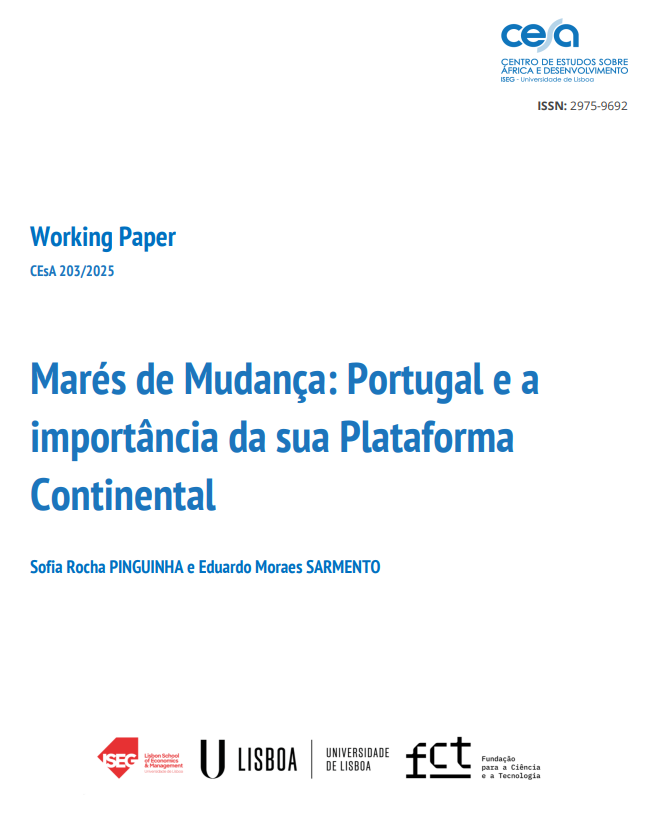
Working Paper 203/2025: Marés de Mudança: Portugal e a importância da sua Plataforma Continental
Abstract:
Portugal, known for its historic maritime traditions, is currently immersed in a strategic ambition regarding the expansion of its continental shelf driven by geopolitical, economic and environmental factors, placing the country before a dynamic maritime scenario full of challenges and opportunities. The rise of the blue economy, synonymous with a sustainable economy, redefines the indispensability of the ocean and its centrality in the balance of building the sustainable development that is sought globally (Cristas, 2022). Using a qualitative methodology, the aim is to reflect on the main benefits that Portugal can obtain from the possible approval of the expansion of its continental shelf, by the United Nations Organisation (UNO). The future, according to the National Strategy for the Sea 2021-2030 (República Portuguesa, 2021), should involve defining a strategy, based on a system of alliances, that will allow Portugal to move forward with the sustainable exploitation of the marine resources (Seguro, 2022).
Cite this Working Paper:
Pinguinha, Sofia Rocha and Eduardo Moraes Sarmento (2025). “Marés de Mudança: Portugal e a importância da sua Plataforma Continental”. CEsA/CSG – Documentos de trabalho nº 203/2025
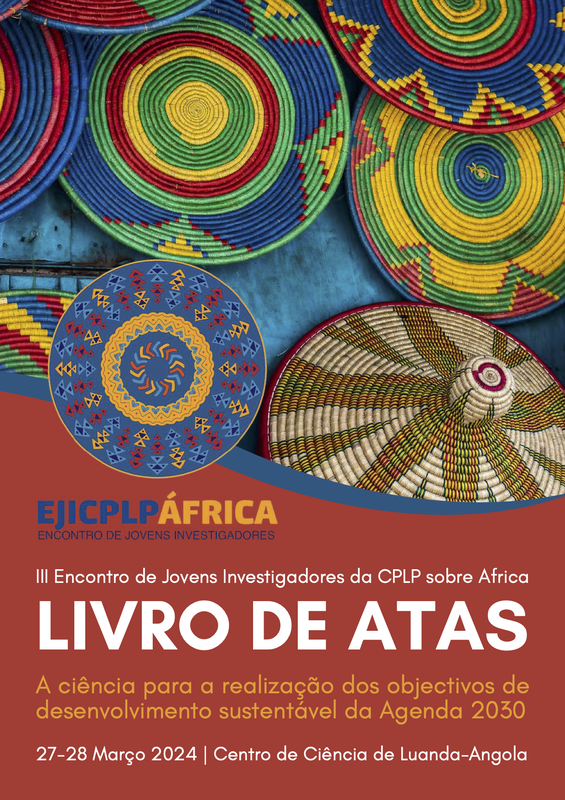
Ebook – 3rd EJICPLP Africa: A ciência para a realização dos Objectivos de Desenvolvimento Sustentável da Agenda 2030
Abstract:
It is with great pleasure that we present the outcomes of the 3rd Meeting of Young Researchers from the CPLP on Africa, held in Luanda on 27 and 28 March 2024. This event, which has already established itself as a key platform for science and development within the Community of Portuguese Language Countries (CPLP), brought together more than 700 participants around the theme “Science for the Achievement of the Sustainable Development Goals of the 2030 Agenda,” fostering a fertile environment for the exchange of ideas, reflections, and collaborations.
With around 30 speakers, including senior researchers, experts, and high-level national and international institutional representatives from various fields of study, eight thematic panels were discussed to deepen knowledge about Africa and its sustainable development, particularly in the areas of Tourism, Energy, Education, Economy, and African Women. The event addressed critical issues related to poverty eradication, environmental protection, and social prosperity. This edition highlighted the role of science in transforming African realities, reflecting on the implementation of the Sustainable Development Goals (SDGs) in the context of the Global South.
The importance of this Meeting goes beyond the impressive number of participants or the lively discussions that marked the two days of activities. The event is a unique scientific forum for young people across the CPLP and brings together a vibrant network of researchers in an itinerant and innovative format. It represents the collective effort of young researchers to give voice to issues that directly affect the development and future of their countries, reinforcing the scientific leadership of CPLP youth.
In this edition, 35 scientific papers by young researchers were presented, selected from among the 65 papers received through the Call for Papers, by a Scientific Committee composed of 30 professors from various universities in CPLP countries.
This book is more than a simple collection of articles; it represents the dedication of young researchers who strive to redefine the role of science in their societies. Through the discussions and analyses presented here, we hope not only to inspire new debates, but also to encourage concrete actions in support of inclusive and sustainable development in CPLP countries.
With the crucial support of the Centre for African and Development Studies (CEsA) and partner organisations such as Angola’s Ministry of Higher Education, Science, Technology and Innovation, and Felcos Umbria, this edition also demonstrates the value of collaboration and international partnerships essential to the success of this project.
We hope these pages offer an enriching perspective on the scientific contributions of Portuguese-speaking youth, as well as concrete actions towards inclusive and sustainable development, particularly in the PALOP countries.
We believe this book marks a milestone on the path towards a more open, collaborative, and transformative science.
Cite this e-book:
D’Abril, Cristina Molares e Jessica Falconi (2024). “III EJICPLP África: A ciência para a realização dos Objectivos de Desenvolvimento Sustentável da Agenda 2030”. ISBN: 978-989-54687-6-8