Lusophone Space

Pathways for Black Studies in Portugal. A New Field of Knowledge and Research
Abstract:
Reflecting on contemporary epistemologies of European Blackness
Long absent from research in the humanities and social sciences, Black people in continental Europe have become the focus of a growing body of literature in the past two decades that addresses their unique history and social positioning. Black Studies in Europe: An Anthology of Soil and Seeds brings together essays and case studies by a collective of scholars, writers, and activists to offer a critical overview of the emerging field of Black European studies and a vital reflection on contemporary epistemologies of European Blackness. This collection addresses key questions: What is Blackness from a European standpoint? Which epistemologies and theoretical tools have been used to offer a better understanding of Black experiences in Europe? How is this knowledge being produced and by whom? Can we define a common European conceptual framework for Black studies? Related to this work is an even more urgent enterprise: forging an epistemological distinction between the study of Black people and “Black studies” as an emancipatory project.

Women’s Agricultural Production in Guinea-Bissau as a Means of Strengthening Their Identity
Abstract:
This article was developed from the study done for the Swiss Cooperation in Guinea-Bissau on women horticulturists. The data were obtained by surveys and interviews in the regions of Bissau, Biombo, Bafatá and Oio, with the producers (which also include a limited number of male producers) of leguminous agricultural products, in a sample of 160/1063 people chosen at random. To better understand the results, it must be said that this business model is not very profitable, but it is an activity that gives a greater independence of women in relation to men in the family space, combating the existing male authoritarianism, since decisions about the use of profits belong to the women producers. It also has a potential environment of action for the affirmation of the social (and not just family) identity of women that should not be despised although, as far as we can see, this is expressed for now only in the organization of associations of producers. The data matrix and the qualitative observations file are the property of SWISSAID, but the tables obtained from it can be provided to researchers who request them.
Cite this Paper:
Sangreman, C., & Melo, M. (2024). WOMEN’S AGRICULTURAL PRODUCTION IN GUINEA-BISSAU AS A MEANS OF STRENGTHENING THEIR IDENTITY. Ars Educandi, 21. https://doi.org/10.26881/ae.2024.21.05

Claude Meillassoux dans la Révolution Mozambicaine
Abstract:
This article stems from a project entitled “Sources for the History of Economic Anthropology: Claude Meillassoux in Mozambique”, which, between January and March 2023, was funded by the programme “Visiting Senior Professor Abroad” (Capes-Print-Ufpr – Capes 88887.757020/2022-00, Brazil). Several people and institutions collaborated in this research over its three-month duration. I am grateful to my French colleagues who, at one point or another in their careers, were close to Claude Meillassoux and provided me with valuable advice and information. My thanks go to Michel Cahen, Jacques Marchand, Antoine Bouillon, Ingolf Diener, Jean Copans, Michel Samuel, Jean-Loup Amselle and Christine Verschuur. Needless to say, any shortcomings in this article are my sole responsibility.
Cite this Paper:
Lorenzo Macagno, « Claude Meillassoux dans la révolution mozambicaine », L’Homme [En ligne], 253 | 2025, mis en ligne le 01 avril 2025, consulté le 18 août 2025. URL : http://journals.openedition.org/lhomme/51517 ; DOI : https://doi.org/10.4000/13olg

Quo Vadis Turismo
Cite this paper:
Sarmento, E. (2025). Quo Vadis Turismo. In Anuário do Turismo de Cabo Verde: A Consolidação dos Produtos Turísticos – 2025 (pp. 14-15). Praia, Cabo Verde.
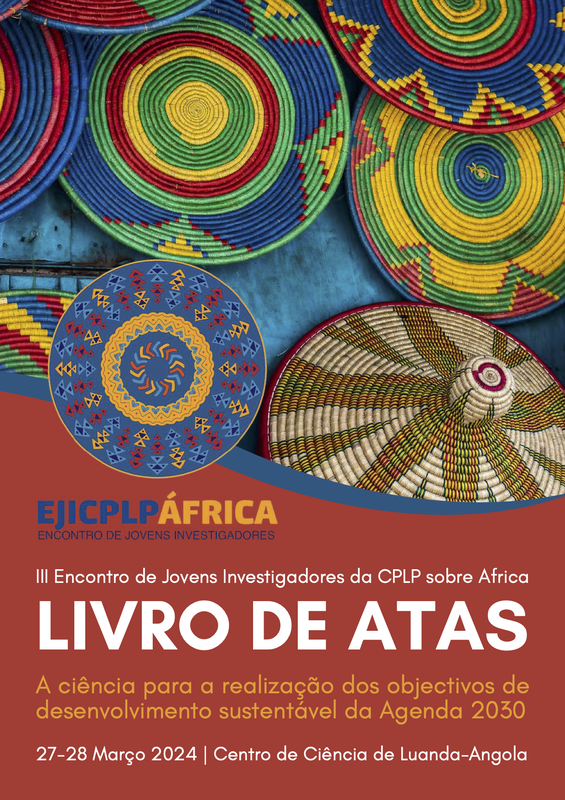
Ebook – 3rd EJICPLP Africa: A ciência para a realização dos Objectivos de Desenvolvimento Sustentável da Agenda 2030
Abstract:
It is with great pleasure that we present the outcomes of the 3rd Meeting of Young Researchers from the CPLP on Africa, held in Luanda on 27 and 28 March 2024. This event, which has already established itself as a key platform for science and development within the Community of Portuguese Language Countries (CPLP), brought together more than 700 participants around the theme “Science for the Achievement of the Sustainable Development Goals of the 2030 Agenda,” fostering a fertile environment for the exchange of ideas, reflections, and collaborations.
With around 30 speakers, including senior researchers, experts, and high-level national and international institutional representatives from various fields of study, eight thematic panels were discussed to deepen knowledge about Africa and its sustainable development, particularly in the areas of Tourism, Energy, Education, Economy, and African Women. The event addressed critical issues related to poverty eradication, environmental protection, and social prosperity. This edition highlighted the role of science in transforming African realities, reflecting on the implementation of the Sustainable Development Goals (SDGs) in the context of the Global South.
The importance of this Meeting goes beyond the impressive number of participants or the lively discussions that marked the two days of activities. The event is a unique scientific forum for young people across the CPLP and brings together a vibrant network of researchers in an itinerant and innovative format. It represents the collective effort of young researchers to give voice to issues that directly affect the development and future of their countries, reinforcing the scientific leadership of CPLP youth.
In this edition, 35 scientific papers by young researchers were presented, selected from among the 65 papers received through the Call for Papers, by a Scientific Committee composed of 30 professors from various universities in CPLP countries.
This book is more than a simple collection of articles; it represents the dedication of young researchers who strive to redefine the role of science in their societies. Through the discussions and analyses presented here, we hope not only to inspire new debates, but also to encourage concrete actions in support of inclusive and sustainable development in CPLP countries.
With the crucial support of the Centre for African and Development Studies (CEsA) and partner organisations such as Angola’s Ministry of Higher Education, Science, Technology and Innovation, and Felcos Umbria, this edition also demonstrates the value of collaboration and international partnerships essential to the success of this project.
We hope these pages offer an enriching perspective on the scientific contributions of Portuguese-speaking youth, as well as concrete actions towards inclusive and sustainable development, particularly in the PALOP countries.
We believe this book marks a milestone on the path towards a more open, collaborative, and transformative science.
Cite this e-book:
D’Abril, Cristina Molares e Jessica Falconi (2024). “III EJICPLP África: A ciência para a realização dos Objectivos de Desenvolvimento Sustentável da Agenda 2030”. ISBN: 978-989-54687-6-8

Entre eu e Deus by Yara Costa: An Unprecedented Representation of the Island of Mozambique
Abstract:
This article aims to dissect the documentary Entre eu e Deus with the primary objective of demonstrating that the director sets out to challenge images, representations and crystallized perceptions of the Island of Mozambique, Mozambican cultural identity and Islamic fundamentalism, and that she succeeds in doing so. The article consists of two main sections. The first provides a brief historical context of the Island of Mozambique and examines some visual representations that predate the documentary under analysis. Here, I pay particular attention to Licínio Azevedo’s documentary on the Island of Mozambique as a relevant antecedent of Yara Costa’s work. The second part provides a detailed analysis of Entre eu e Deus, demonstrating the director’s unprecedented representation of the Island of Mozambique.
Cite this Paper:
Falconi, J. (2024). Entre eu e Deus by Yara Costa: An Unprecedented Representation of the Island of Mozambique. Portuguese Studies 40(2), 175-188. https://dx.doi.org/10.1353/port.00014.

African women’s trajectories and the Casa dos Estudantes do Império
Abstract:
This article compares the trajectories of different women who crossed the Casa dos Estudantes do Império (CEI), a formal institution created in Lisbon by students from the colonies with the support of the Portuguese dictatorial regime in 1944, that became a platform for anti–colonialism. Due to the role played by the CEI in the political and social paths of the leaders of African national liberation movements, historiography has privileged masculine accounts. In contrast, the roles and lives of women linked to the CEI remain unexplored or approached from a vision of “methodological nationalism”, with few exceptions. Addressing these trajectories from a transnational and “Afro–Iberian” lens and through the scrutiny of several sources allows us to reflect on a diversity of gender, race, class, and political ideology. The final aim is to illuminate some aspects of the Afro–Iberian mosaic from a gendered and postcolonial perspective.
Cite this Book Chapter:
Falconi, J. (2024). African women’s trajectories and the Casa dos Estudantes do Império In: Ethnicity and Gender in Portugal and Spain. volume 47, issue 7 (2024), pp. 1403-1419
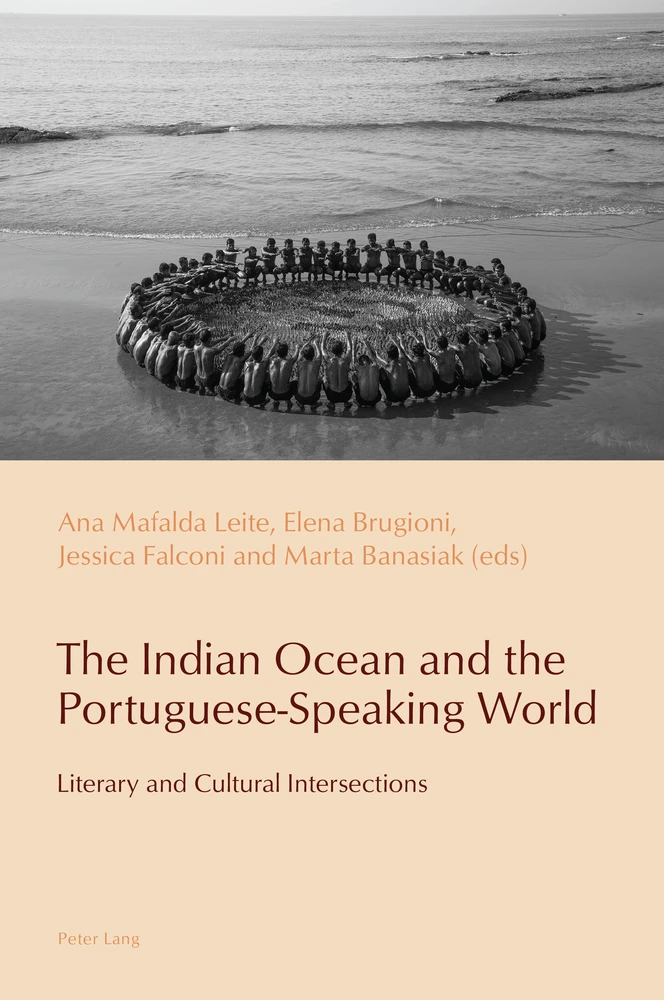
The Indian Ocean and the Portuguese-Speaking World: Literary and Cultural Intersections
Abstract:
Working from the premise that the Indian Ocean shapes new transnational imaginative geographies, this volume analyses how visual and written narratives from Lusophone, or rather «Lusotopic», spaces – Portugal, Mozambique, East Timor and Goa – point to productive critical dialogues with existing theories in Indian Ocean studies. The conceptual and epistemological revision presented in the book allows for the emergence of different theoretical constellations that are not solely based on the opposition between coloniality and the postcolonial condition, nor grounded upon the concept of linguistic or national identity, pointing to a set of original critical developments within the area of Indian Ocean studies.
Cite this book:
Leite, A., M., Brugioni, E., Falconi, J., Banasiak, M. (2025). The Indian Ocean and the Portuguese-Speaking World. Literary and Cultural Intersections. Oxford, United Kingdom: Peter Lang Verlag. Retrieved Dec 13, 2024, from 10.3726/b17729
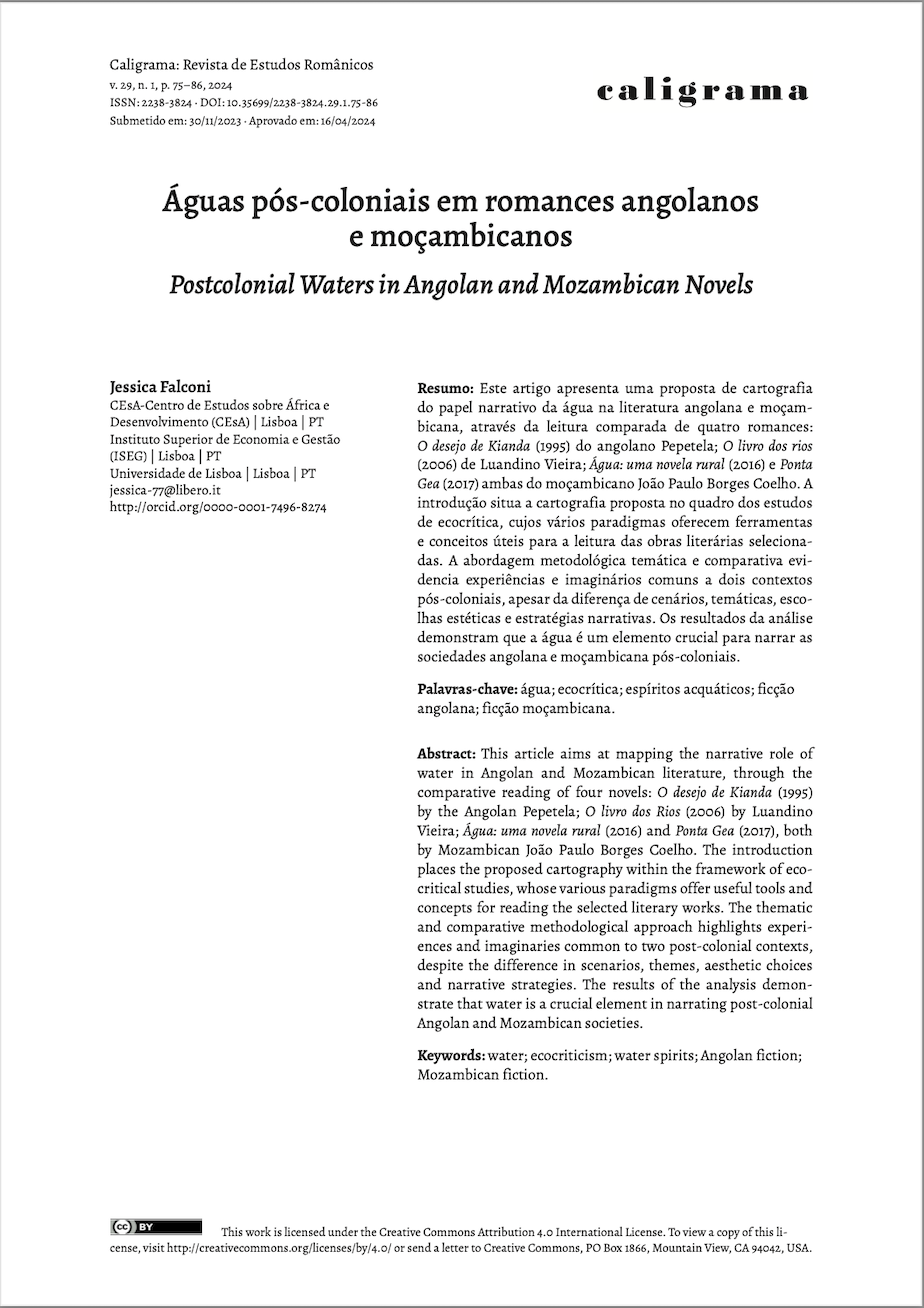
Águas Pós-coloniais em Romances Angolanos e Moçambicanos
Abstract:
This article aims at mapping the narrative role of water in Angolan and Mozambican literature, through the comparative reading of four novels: O desejo de Kianda (1995) by the Angolan Pepetela; O livro dos Rios (2006) by Luandino Vieira; Água: uma novela rural (2016) and Ponta Gea (2017), both by Mozambican João Paulo Borges Coelho. The introduction places the proposed cartography within the framework of ecocritical studies, whose various paradigms offer useful tools and concepts for reading the selected literary works. The thematic and comparative methodological approach highlights experiences and imaginaries common to two post-colonial contexts, despite the difference in scenarios, themes, aesthetic choices and narrative strategies. The results of the analysis demonstrate that water is a crucial element in narrating post-colonial Angolan and Mozambican societies.
Cite this article:
Falconi, Jessica (2024). “Águas pós-coloniais em romances angolanos e moçambicanos”. Caligrama: Revista de Estudos Românicos, 29(1):75-86
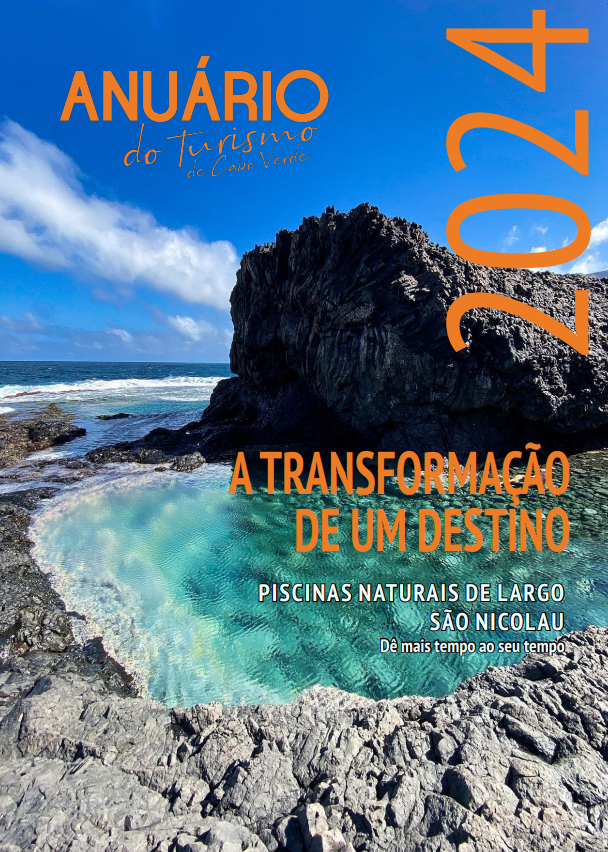
Turismo Costeiro e Marítimo em Cabo Verde. Rumo a um destino sustentável
Cite this paper:
Sarmento, E. (2024). Turismo costeiro e marítimo em Cabo Verde. Rumo a um destino sustentável. In Morgado, Carlos (2024). Anuário do Turismo de Cabo Verde 2024: a transformação de um destino (pp.30-32). Praia, Cabo Verde.