Working Papers
For submission of articles or Working Papers to CEsA, please send an email to:
comunicacao@cesa.iseg.ulisboa.pt
Working Paper 78/2009: Uma proposta de Observatório da Cooperação portuguesa
Abstract:
In Uma proposta de Observatório da Cooperação portuguesa we study the discussion on the impacts of development aid that has evolved in the sense of recognizing the complexity of elements that condition the evolution of well-being and economic growth indicators in developing countries. In this way, the search for explanations for the persistence or even worsening of poor living conditions in the developing countries and the scarcity of ODA results has paved the way for reflection on the functioning of international institutions and aid, noting, for example, the need to strengthen their accountability, transparency and participation mechanisms (Wenar, 2006: 1). However, the recognition, within the international community of donors, that the management and governance models of international aid are not adequate to the international objectives of reducing poverty in the developing countries, often contributing to exacerbate the weaknesses of their public administration systems , being at the same time not very transparent and scrutiny, is relatively recent, from the late 90s of the 20th century. It is in 2005, with the Paris Declaration on Aid Effectiveness, that a commitment is reached between OECD DAC countries and partner countries to reform the way in which development aid is provided and managed. In this sense, principles of action for donors and recipients were defined in order to a) support the strengthening of capacities in developing countries to define their priorities and poverty reduction strategies, improving their institutions and fighting corruption; b) align development aid with the objectives defined by the developing countries and with the local systems of administration; c) harmonizing the actions of donor countries, avoiding duplication of efforts and simplifying administrative and bureaucratic procedures, in order to make the implementation of aid on the ground more effective and efficient; d) focus aid on the results to be achieved (and on their measurement); e) to hold both donors and partners accountable for the results achieved by development aid (OECD, 2005). Since 2005, the countries of the South, in a context of change in the international system with the entry of new actors in cooperation for development, such as China, have been reinforcing their voice in the discussion of global governance. In this sense, they have been proposing changes to improve the predictability of aid, change technical assistance and make it dependent on developing countries (and not on donors), reduce conditionality, use national systems and strengthen South-South cooperation (Schulz , 2008: 2). In fact, the construction of more balanced relations in the international system of cooperation for development takes place in a context of great imbalance of power in which the risk tends to always be assumed by the poorest countries (ODI, 2006: 2). In this way, it is important to include in the discussion of global governance, the role of citizens in donor countries (and their relations with the citizens of the South), to which donors respond directly, viewing them as elements in a chain of connection between citizens and governments of the South and the governments of the countries of the North. It is in this chain of feedback mechanisms at various levels, which makes the governance of cooperation very complex, that it seems fundamental to us to look for the concrete mechanisms that promote multilevel governance in cooperation.
Quotation:
Sangreman, Carlos e Tânia Santos. 2009. “Uma proposta de Observatório da Cooperação portuguesa”. Instituto Superior de Economia e Gestão. CEsA – Documentos de Trabalho nº 78/2009.
Working Paper 77/2009: Avaliando a cooperação descentralizada: pistas para um modelo com aplicação empírica
Abstract:
Since the object of Avaliando a cooperação descentralizada : pistas para um modelo com aplicação empírica is the search for clues for new forms of evaluation in Decentralized Cooperation, it will only touch the question of evaluation focused on results laterally – in the tendentially dominant definition of “results” as that which is quantifiable. In fact, empirical knowledge leads to questioning the recent orientation of “management by results”, defined by most international donors. It is a question of questioning whether this orientation does not in itself imply a devaluation of the role of evaluation, since monitoring and performance reports are designed to contain, in principle, only the elements sufficient to allow the function of controlling results, in a summative evaluation model. This document will, therefore, pay particular attention to issues related to the elements of differentiation and added value expected in the CDD, which implies that we focus primarily on topics such as the evaluation of the process, the participation of the actors, the links between the and impact, between qualitative results and sustainability, as well as issues related to innovation and experimentation. It will also look at assessment as a way of validating strategies and updating knowledge – in short, looking for clues to configure an assessment that does not focus on the control function, but rather the assessment that seeks to focus on the joint learning function. , in capacity building to improve future intervention.
Quotation:
Proença, Fátima. 2009. “Avaliando a cooperação descentralizada : pistas para um modelo com aplicação empírica”. Instituto Superior de Economia e Gestão. CEsA –Documentos de Trabalho nº 77/2009.
Working Paper 76/2009: A exclusão social em Cabo Verde: uma abordagem preliminar
Abstract:
A exclusão social em Cabo Verde: uma abordagem preliminar is an introductory study of the issue of social exclusion in Cape Verde, being an innovative topic for the country, faced a problem of lack of academic and social background reflections. In other words, on the one hand, there are few or no research works in the university world on the subject of social exclusion in less developed countries, defending the more or less consensual thesis in the scientific community, that the dominant phenomenon is poverty and not social exclusion; on the other hand, Cape Verde is a country in transition quite successfully from a lower level of development to a higher one. As a result, it finds itself in the situation of still having many problems of poverty, but it is probably already beginning to contain the germs of social exclusion in its social fabric, making a process very similar to that of European countries. This situation gives rise to a deep articulation between poverty and exclusion and makes it difficult to distinguish one from the other in the country’s development process. But it also implies an increasingly evident need to reflect on a topic that runs the risk of being (unconsciously or not) socially hidden and the object of public policies only when it has already reached dimensions that seriously affect social cohesion.
Quotation:
Sangreman, Carlos. 2009. “A exclusão social em Cabo Verde: uma abordagem preliminar”. Instituto Superior de Economia e Gestão. CEsA – Documentos de Trabalho nº 76/2009.
Working Paper 75/2008: Modelização dos determinantes da pobreza em Cabo Verde
Abstract:
The poverty profile gives information about who is poor, but it cannot be used to accurately assess the determinants of poverty. One of the advantages of the determinants of poverty is the impact of several variables on the probability of being poor while controlling for other regression variables. In Modelização dos determinantes da pobreza em Cabo Verde, regression analysis is performed taking into account the means of residence (urban and rural). The database used is from the Survey on Family Expenses and Income (IDRF) prepared by the National Statistics Institute (INE) in 2001/02. This article corresponds to a sub-chapter of the dissertation entitled “Poverty in Cape Verde: a contribution to multidimensional modelling”, presented by Fernandes, J. Moniz, (2004), as a partial requirement to obtain a Master’s degree in Statistics and Information Management, by the Instituto Superior de Estatística e Gestão de Informação of the Universidade Nova de Lisboa. On the one hand, the aim of this study is to model household poverty levels on the Cape Verde islands. On the other hand, it is hoped to contribute to identifying a set of variables that better explain the phenomenon of poverty in Cape Verde and eventually provide the social authorities (National Programme for the Fight Against Poverty – PNLP and Directorate General of Planning) with important information for decision making.
Quotation:
Fernandes, José Moniz Lopes. 2008. “Modelização dos determinantes da pobreza em Cabo Verde”. Instituto Superior de Economia e Gestão. CEsA – Documentos de Trabalho nº 75/2008.
Working Paper 74/2008: De Macau a Ou Mun: a evolução da economia de Macau nos últimos anos da administração portuguesa e nos primeiros da administração chinesa
Abstract:
De Macau a Ou Mun: a evolução da economia de Macau nos últimos anos da administração portuguesa e nos primeiros da administração chinesa is a (much) revised and enlarged version of another one entitled “Casino Macau”, published by CEsA in 2006 as one of its Working Papers. However, substantial changes to the points of view advanced in the initial document are not expected. They are (almost) all of them already there, and we are now concerned with going deeper into documenting the ideas presented and approaching, with appropriate statistical information, the economic evolution of Macau in the last years of the Portuguese administration and in the first of the Chinese administration. What was essential in this deepening of the initial text was the possibility of approaching these issues with specialists resident in Macau through interviews carried out on site in June/2007 and a more in-depth treatment of the available statistical information. The text was written, essentially in 2007, but for various reasons it is only now possible to publish it. At the end there is a post-scriptum that gives some more current information (September/2008).
Quotation:
Serra, António M. de Almeida. 2008. “De Macau a Ou Mun: a evolução da economia de Macau nos últimos anos da administração portuguesa e nos primeiros da administração chinesa”. Instituto Superior de Economia e Gestão. CEsA – Documentos de Trabalho nº 74/2008.
Working Paper 73/2007: Os ‘clusters’ e a reforma da Administração Pública na cooperação internacional portuguesa para o desenvolvimento
Abstract:
The objective of Os ‘clusters’ e a reforma da Administração Pública na cooperação internacional portuguesa para o desenvolvimento is to be a contribution to the knowledge in theory and in the practical operationalization of the new instrument of Portuguese cooperation for development – the cooperation clusters – with regard to the beneficiary countries of international aid and also in the effect that its creation and implementation can have on the reform of public and private cooperation institutions in Portugal, especially at the Institute for Development Support (IPAD) in what we call the “boomerang effect”. As for the theoretical dimension, we argue that only linking this concept to that of benchmarking, as understood in the ongoing Public Administration reform process, will make it possible to make it a real policy measure – as opposed to virtual measures announced and never operationalized – and with an innovative contribution to the reform of public institutions and non-state actors that constitute the actors in the field of Portuguese Cooperation (PC), within the current international consensus on the area and in the current Government’s Public Administration Reform policy. As for practical operationalization, we defend an implementation, perfectly feasible and not utopian, which involves a flexible operational model with which to develop cooperation programs suited to the priorities existing in each country, using the methodology of partnership and evaluation of results that are of the highest quality and as participatory as possible in all phases of identification, design, implementation and evaluation, always taking into account the political options of Portugal and the partner countries, as well as the coherence, consistency and institutional capacity of both. Experiences from other countries that finance the Cooperation were sought, as well as mentioning the cluster whose conception is more advanced in Portugal – the Island of Mozambique -, and presenting proposals for the operationalization of clusters that may constitute a standard of what Portugal can propose to countries with which have cooperation. These proposals also extend what we think can be the transformation in Portuguese institutions of the “countryside” in the light of the ideas expressed here.
Quotation:
Sangreman, Carlos e Fernando Carvalho. 2007. “Os ‘clusters’ e a reforma da Administração Pública na cooperação internacional portuguesa para o desenvolvimento”. Instituto Superior de Economia e Gestão. CEsA – Documentos de Trabalho nº 73/2007
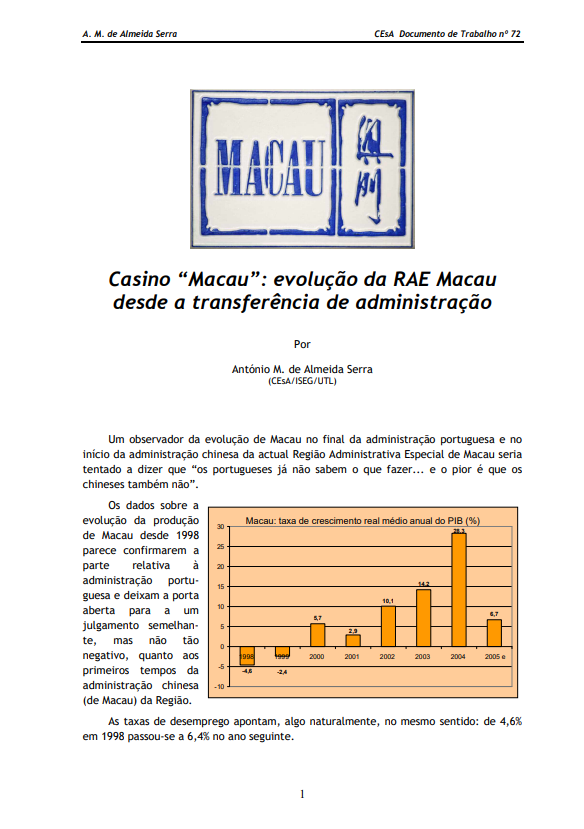
Working Paper 72/2006: ‘Casino Macau’: evolução da RAE Macau desde a transferência de administração
Abstract:
Casino Macau’: evolução da RAE Macau desde a transferência de administração is mainly intended to constitute a tour d’horizon on the main lines of evolution of Macau after the transfer of its administration to the People’s Republic of China. This, as is known, took place at zero hours of December 20, 2000, a date chosen to ensure that the transfer of administration took place after that of Hong Kong, a “point of honor” on the Portuguese side, as it ensured that Portugal , the first European country to arrive in Asia, would be the last to leave. The difficulties that the territory’s economy experienced in the last years of the Portuguese administration (see the unemployment rates and negative growth rates that occurred at the time and which were due, in part, to phenomena outside Macau such as the Asian crisis of 1997-98) could justify extending this line of “break” with the past to the economy, even within the general framework of the commitment to “one country, two systems”. Those economic difficulties would most likely be felt even without an unfavorable international economic context due to the exhaustion of what we could call the “model of great works” that had characterized the economic policy implemented by Portugal, particularly from the governments of the Comte. Almeida e Costa (1981-86), who prepared many of the projects to be implemented and who would have been the real outliner of Macau’s future as a “Chinese territory under Portuguese administration, and Carlos Melancia (1987-90), who was responsible for carrying out many of the planned works and others. It was in this context that, with the (illusory?) objective of giving Macau a relative autonomy vis-à-vis Hong Kong and even the contiguous area of People’s China (Guangdong/Canton province) that it reduced its dependence on its neighbors , the construction of various infrastructures was launched (namely the airport, the port and the power station, but also bridges connecting the Macau peninsula and the island of Taipa) and agreements were negotiated with institutions outside Macau — namely international organizations such as the European Union, the GATT, etc.
Quotation:
Serra, António M. de Almeida. 2006. ‘Casino Macau’: evolução da RAE Macau desde a transferência de administração”. Instituto Superior de Economia e Gestão. CEsA – Documentos de Trabalho nº 72/2006.
Working Paper 71/2006: Timor Leste: o petróleo e o futuro
Abstract:
Timor Leste: o petróleo e o futuro has as its fundamental objective the presentation of the main information on the “petroleum economy” of East Timor, clearly assuming a more descriptive function than a critical analysis of it. For this reason, it should not be understood as a “scientific communication” to the VI EELP. It highlighted the difficulties that the country has faced in its negotiations with Australia to define its share of resources in the Timor Sea, which in its opinion should correspond to 100% since the main producing wells will be in its area. exclusive economic activity defined in accordance with the International Law of the Sea. Unfortunately, it was not possible to convince Australia of the goodness of this position and it ends up appropriating an important volume of resources that should belong to East Timor. One of the consequences of this is that Australia ends up financing part of its international aid to East Timor… with money improperly appropriated from it!… We also pointed out that the resources currently available are much greater than initially estimated due to the significant increase of oil prices on the international market. Furthermore, these resources can be greatly increased if, as is believed, the existence of oil both onshore and offshore is confirmed, but in the area where the total and complete sovereignty of Timor is unequivocally recognized. Finally, we mention that, materializing the desire to preserve most of the country’s oil wealth for future generations, the Government decided to establish a Petroleum (financial) Fund applied only abroad in order to avoid “Dutch disease” reactions in the country. national economy. The benefits for the present generations will be those that will come from the financing, by the Fund, of the General State Budget and of the expenses (namely of development) covered by it. These transfers will represent almost 2/3 of the Budget’s revenues and will amount to approximately USD 140 million in the next fiscal year (2006/07), then decreasing to approximately USD 110 million in the following three years.
Quotation:
Serra, António M. de Almeida. 2006. “Timor Leste: o petróleo e o futuro”. Instituto Superior de Economia e Gestão. CEsA –Documentos de Trabalho nº 71/2006.
Working Paper 70/2006: A evolução política recente na Guiné-Bissau: as eleições presidenciais de 2005, os conflitos, o desenvolvimento, a sociedade civil
Abstract:
The purpose of A evolução política recente na Guiné-Bissau: as eleições presidenciais de 2005, os conflitos, o desenvolvimento, a sociedade civil is to contribute to the identification of some of the main social and political reasons of the Guinea-Bissau reality that were decisive in the electoral behavior that led to the election in 2005 of João Bernardo Vieira “Nino” for the presidency of the Republic against the candidate nominated and supported by PAIGC, Malam Bacai Sanhá. We tried to combine the previous knowledge of the country, through academic activity and technical work in the field on different occasions, with the attentive observation of the electoral process, including the presence of two of the authors’ team members in the Observation Mission of the international community in the elections, to to analyze various aspects of the evolution of that country that are considered relevant for the population of around 600,000 voters to elect Nino Vieira president, after having lost an eleven-month civil war and exile in Portugal since 1999. The evolution process of development human and sustained, the role of civil society in this process and the social and military conflicts are themes that seem to us to be significant – although not exhaustive – for this result. We are aware that it will be necessary to bring together different analyzes by researchers with different training on other topics until we have a broad and in-depth perspective on all possible aspects of the evolution of the individual and collective well-being of the population of that country. The conclusions stem from scenarios that we believe are possible, at the time of writing, for the near future and that we will complete as our perception of reality develops with contributions from other authors in articulation or not with this team. For these texts, we have the aggregated results by presidential candidate from the 1994, 1999 and 2005 elections, as well as their breakdown by region in the second round. We also have access to a bibliography of authors from Guinea and other nationalities on the electoral phenomenon, development, conflicts, civil society and our own knowledge of the country’s reality. We are not aware of opinion polls on electoral behavior in the country. The investigation we carried out on the polls carried out in the 2005 campaign reveals that these were just propaganda actions for different candidacies and did not follow any methodology that would allow them to be considered the expression of some representation.
Quotation:
Sangreman, Carlos … [et al.]. 2006. “A evolução política recente na Guiné-Bissau: as eleições presidenciais de 2005, os conflitos, o desenvolvimento, a sociedade civil”. Instituto Superior de Economia e Gestão. CEsA – Documentos de Trabalho nº 70/2006
Working Paper 69/2005: A administração belga face à presença asiática na região dos Grandes Lagos: do período de ocupação aos anos 30
Abstract:
In A administração belga face à presença asiática na região dos Grandes Lagos: do período de ocupação aos anos 30 we study how the Asian question presents itself as one of the dominant themes of colonial management in East, Central and Eastern and Southern Africa during the 20th century. The settlement in those territories of peoples from the Arabian Peninsula, the Persian Gulf and the Indian subcontinent, a heritage transmitted to the African societies of the western Indian Ocean during more than a millennium of transoceanic contacts, constituted, in the first decades of European occupation, a common feature of both their human and cultural landscape as well as its economic life. By the 1930s, therefore, the administration’s intention to manage the interests of the Asian community was visible. Indeed, in a colonial context in which the majority of the African population was reserved, above all, the function of producing, emigrating and fulfilling tax obligations, given the inexistence of white colonization and, finally, given the limited presence of small European commerce, namely of Greek, Italian and Indo-Portuguese origin, it was Arab and Hindu traders who, for the most part, would be called upon to assume the internal dynamism of commercial activity. Hence the importance that these Asians assume in the history of Belgian occupation in the Great Lakes region.
Quotation:
Leite, Joana Pereira. 2005. “A administração belga face à presença asiática na região dos Grandes Lagos: do período de ocupação aos anos 30”. Instituto Superior de Economia e Gestão. CEsA – Documentos de Trabalho nº 69/2005.