Working Papers
For submission of articles or Working Papers to CEsA, please send an email to:
comunicacao@cesa.iseg.ulisboa.pt
Working Paper 68/2005: Crescimento económico, desenvolvimento humano e pobreza: análise da situação em Moçambique
Abstract:
Starting from the case of Mozambique, the main objective of Crescimento económico, desenvolvimento humano e pobreza: análise da situação em Moçambique is to discuss the connection between economic growth and poverty reduction. To this end, we will confront different perspectives and outcomes of poverty in Mozambique. At first, it will be inevitable to start a previous discussion on some conceptual and methodological aspects. The first section of this work will therefore be entirely devoted to a discussion around the definition, identification and measurement/aggregation of poverty. For poverty reduction, growth alone is not a sufficient condition. The nature of the growth is also important. In the case of Mozambique, economic growth was favorable to the poorest strata and would certainly have been favored by a good orientation of social policies, although this issue remains to be analyzed in detail. To better understand the causal processes that make it possible to establish a relationship between growth and poverty reduction, more complete data at the macro level would be needed, as well as a deeper micro knowledge of family strategies (livelihood) in the face of macroeconomic transformations. However, it is already possible to perceive that the strong reduction of poverty in the rural sector compared to the urban sector clearly reflects an economic growth more favorable to rural populations, where poverty has a higher incidence. It can thus be considered that the sectoral economic growth less biased to the detriment of rural areas, contrary to what happened in the past, was positive in reducing absolute poverty. On the other hand, the human development index and the human poverty index reflect the importance of investments made in human capital, particularly in the education sector.
Quotation:
Vieira, Sérgio Pires. 2005. “Crescimento económico, desenvolvimento humano e pobreza: análise da situação em Moçambique”. Instituto Superior de Economia e Gestão. CEsA – Documentos de Trabalho nº 68/2005
Working Paper 67/2005: A política portuguesa de cooperação para o desenvolvimento
Abstract:
In A política portuguesa de cooperação para o desenvolvimento it is studied how the development cooperation policy is often described as an essential vector of Portuguese foreign policy, acquiring, to that extent, particular strategic significance. In this sense, and based on the analysis of the main lines of Portuguese foreign policy, the importance given to strengthening relations with the Portuguese-speaking space stands out, namely through the projection of values and interests in the PALOP, Brazil and Timor (MNE, 2003a), as well as the defense and affirmation of the Portuguese language and culture, aspects that, according to the XV Government Program (2002-2004), contribute to the affirmation of national identity. The Portuguese language and culture are considered main strategic elements (language is a decisive factor in the new world order through the geopolitics of language), and, in this plan, Portugal is proportionally more relevant on a planetary scale than in its political dimensions, social or economic. In the general lines of external action, this aspect is more easily perceptible. The acceleration of European integration and the blurring of borders in Europe must correspond to a greater affirmation of national identity, expressed in the projection, both internally and externally, of the Portuguese language and culture and in the valorization of the historical legacy: “the cultural factor is perhaps a of the most powerful elements of our identity, which is, after all, what separates and differentiates us from all other peoples in globalization on a world scale” (MNE, 2003b). Thus, it seems fundamental for Portuguese foreign policy to know how to reconcile two of its main axes: maintaining a close connection to the community of Portuguese-speaking countries in the world, on the one hand, and active participation in European construction, on the other. As for the cooperation policy, this is simultaneously seen as a vehicle for the affirmation and expansion of Portuguese influence at an international level and as an instrument for achieving national strategic objectives.
Quotation:
Mesquita, Ana Guedes. 2005. “A política portuguesa de cooperação para o desenvolvimento”. Instituto Superior de Economia e Gestão. CEsA – Documentos de Trabalho nº 67/ 2005
Working Paper 66/2003: Les indians dans la presse coloniale portuguaise du Mozambique 1930-1975
Abstract:
In order to organize an intelligible reading of the facts and events reported by the Laurentian press between 1930 and 1975, we started from a hypothesis which, for ideological reasons linked to the form taken by Salazarist nationalism and its avatars, had difficult to express in a simple and explicit way. This starting hypothesis concerned the nature of the Estado Novo which defined for the first time in the history of the Portuguese Empire, a social and cultural field common to the different groups constituting the society of the colony, of which the Indians were stakeholder. This hypothesis, which we tested in Les indians dans la presse coloniale portugaise du Mozambique 1930-1975 through the Laurentian press from the 1930s to 1975, is confirmed by the concrete measures taken by the government of the colony vis-à-vis the entire Indian community. Nevertheless, the latter remained vulnerable to the discriminatory practices specific to colonial society whenever political events threatened the Empire. We have noted that this vulnerability was experienced in a differentiated way according to religious affiliations (Hindu, Muslim and Catholic), according to the status conferred by the authorities (Indo-Portuguese, Indo-British then Pakistani, Hindustani and Indo-Portuguese) and according to the place occupied in socio-economic stratification. This overview and analysis of the Laurentian press during the Estado Novo period shed light on the understanding of the dual destiny of the Indian community, both in Portugal and in Mozambique from 1975 onwards. shared all the signs of cultural assimilation to the Portuguese nation, and that it was not reduced to the sole role of “middleman” or economic agent in its experience within colonial society, that it can henceforth directing its destiny either in Portugal or/and in the Mozambican nation which remains to be built.
Quotation:
Khouri, Nicole e Joana Pereira Leite . 2003. “Les indians dans la presse coloniale portugaise du Mozambique 1930-1975”. Instituto Superior de Economia e Gestão. CEsA –Documentos de Trabalho nº 66/2003.
Working Paper 65/2003: Os trabalhadores moçambicanos na antiga República Democrática Alemã: passado e presente
Abstract:
For more than ten years, from 1979 until the end of the German Democratic Republic in 1990, the Government of Mozambique maintained a migration of thousands of workers to East Germany. The main, although hidden, purpose of this migration was the servicing of the increasingly unsustainable debt incurred with the GDR. In many respects this migration was similar to the employment of Mozambican miners in South Africa during the colonial period: a paternalistic legal and institutional framework, employment of single youths on a rotating basis, deferred payment, housing and social segregation in the host country. The implosion of the GDR lead to a hasty repatriation of the Mozambican workers and to an open conflict between the returnees and the Government concerning wage and social security transfers for which the workers feel wronged. To voice their claims they take advantage of the newly established civil liberties and democratic institutions in Mozambique. Os trabalhadores moçambicanos na antiga República Democrática Alemã : passado e presente assesses this largely ignored phenomenon of contemporary migration by drawing upon some untapped primary sources, less accessible secondary material and interviews, both in Germany and in Mozambique. It may equally contribute to clarify some contentious issues in the ongoing conflict.
Quotation:
Oppenheimer, Jochen .2003. “Os trabalhadores moçambicanos na antiga República Democrática Alemã : passado e presente” . Instituto Superior de Economia e Gestão. CEsA – Documentos de Trabalho nº 65/ 2003.
Working Paper 64/2002: A metodologia do estudo da pobreza através da evolução dos níveis de vida Bissau 1986/1991 (com referências a 1993)
Abstract:
Guinea-Bissau has a remarkable record of household surveys in Sub-Saharan Africa. The first known one is from 1980/81, followed by another in 1986/87 with a valid sample essentially for Bissau, both with the main purpose of obtaining a pattern of household expenditure that would allow the calculation of a price index – based on the 1986 basket, with adaptations resulting from subsequent surveys. Under the World Bank’s Social Dimensions of Adjustment in Sub-Saharan Africa (SDA) programme, a third was carried out in 1991, covering the entire country, and a fourth in 1993/94. The study on the evolution of poverty through living standards between 1986 and 1991 aims at a period that corresponds to the beginning of the structural adjustment program that still continues today. We intend, in A metodologia do estudo da pobreza através da evolução dos níveis de vida Bissau 1986 /1991 (com referências a 1993), to take advantage of previous works, namely Dianne Marleau’s 1989 study on poverty alleviation, which worked with data from 1986 and the poverty profile, produced by the World Bank for its Report on the situation of poverty in 1993.
Quotation:
Costa, Francisco . Augusto Moreira e Carlos Sangreman .2002. “A metodologia do estudo da pobreza através da evolução dos níveis de vida Bissau 1986 /1991 (com referências a 1993)”. Instituto Superior de Economia e Gestão. CEsA – Documentos de Trabalho nº 64/ 2002
Working Paper 63/2002: O desenvolvimento humano e os investimentos em formação médica: o caso de Moçambique
Abstract:
This working paper, O desenvolvimento humano e os investimentos em formação médica: o caso de Moçambique, aim is to to analyze human development from the perspective of public and private agents responsible for investments in medical training (formal education) in Mozambique. The realization that over the last few decades socio-economic policies have been privileged in order to achieve sustained growth makes us feel that there is an evolution in the very concept of development. When we currently talk about development, we are referring to such complex issues as, for example, individual and/or collective well-being, poverty reduction; we are talking about human development, where the variables for its quantification are income, health and education. Knowing that investments in education and health have a direct impact on the Human Development Index, we can think that investment in human capital will produce returns expected by the various economic agents in the long term, thus improving the quality of life of the populations that make it.
Quotation:
Sousa Jr., Fernando de. 2002. “O desenvolvimento humano e os investimentos em formação médica: o caso de Moçambique”. Instituto Superior de Economia e Gestão. CEsA(Centro de Estudos sobre África e Desenvolvimento) – Documentos de Trabalho nº 63/2002.
Working Paper 62/2001: O consenso internacional na luta contra a pobreza e a cooperação para o desenvolvimento em S. Tomé e Príncipe
Abstract:
The fight against poverty is the central axis of cooperation. In other words, within each area, the priority actions are those that the international community consensually considers in recent years to be most effective in the fight against poverty, as will be exemplified later. In O consenso internacional na luta contra a pobreza e a cooperação para o desenvolvimento em S. Tomé e Príncipe, as a methodology to determine the content of this consensus, reports from different specialized agencies of the UN (ILO, IFAD, WHO, UNESCO) and the WB/IMF were sought. Thus, we tried to use publications where the international community continues to debate the alternatives of strategies, policies and instruments with which it seeks to solve the problem of the persistence of inequalities in the development of the group of countries in the world. In cross-cutting areas, strengthening governance institutions and civil society is a priority. Thus, this area prevails over the other transversal areas such as gender, environment, statistics. And within this area, cooperation with institutions that have responsibilities in the area of fighting poverty prevails, such as the Ministries of the social area and of work/employment, the municipalities in the areas with the highest poverty index (extent and severity) the organizations of secular and religious civil society working with vulnerable groups (in São Tomé and Príncipe the elderly, landless farmers, female heads of households). In the sectoral areas, priority goes to agriculture, education, health and social protection, as a safety net for the poorest, once again prioritizing actions that directly attack poverty in relation to other actions in the same areas.
Quotation:
Sangreman, Carlos. 2001. “O consenso internacional na luta contra a pobreza e a cooperação para o desenvolvimento em S. Tomé e Príncipe”. Instituto Superior de Economia e Gestão CEsA – Documentos de Trabalho nº 62/ 2001
Working Paper 61/2001: Como induzir o desenvolvimento em África?
Abstract:
The research carried out in Como induzir o desenvolvimento em África? allows us to conclude that, in order to obtain the investment, it must be oriented towards: (i) Making cheap money available to the national business sector in order to increase demand from the family sector through agro-industry; (ii) The establishment of new type partnerships between the business and family sectors, the latter having as capital the natural resources of the area it occupies and the former the technology and know-how of management and access to markets; (iii) The development of human capital, in particular through basic education, improving the quality of drinking water and general sanitation conditions; (iv) Reducing distances related to services, markets and resources through the construction of infrastructure and the progressive replacement of wood fuels with electric and fossil fuels; (v) In the reconstitution of the institutional fabric, having as principles the participation at all levels in the decision-making processes, the balance in gender relations and the incorporation of endogenous and transversal institutions in the dynamics of governance.
Quotation:
Negrão, José Guilherme. 2001. “Como induzir o desenvolvimento em África?”. Instituto Superior de Economia e Gestão. CEsA (Centro de Estudos sobre África e Desenvolvimento) – Documentos de Trabalho nº 61/2001.
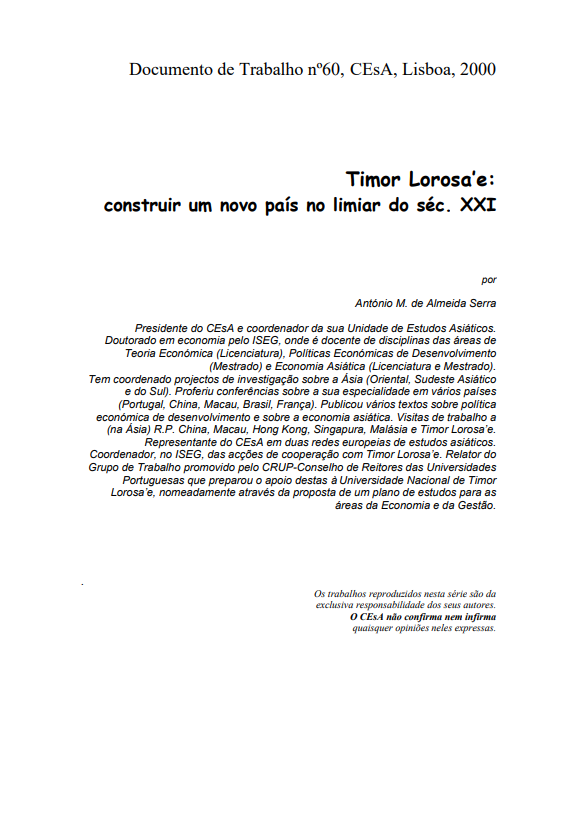
Working Paper 60/2000: Timor Lorosa’e: construir um novo país no limiar do séc. XXI: propostas de estratégia e de políticas económicas de desenvolvimento
Abstract:
Timor Lorosa’e is currently at a crucial stage in its life as a country as the political structure that has represented its people so far is preparing to define some of the guidelines for the future Timor Lorosa’e. Similar to what happened with our previous text, the main objective of this one is to present some proposals for the main lines of development of Timor Lorosa’e in the hope of being able to contribute to the debate on them. Thought to be ready some time before the Congress of the CNRT-National Council of Timorese Resistance, it ended up being written before, during and after this relevant event in the life of the country in formation. Some of the ideas presented were ‘fine-tuned’ during the work of the aforementioned Congress, which we had the opportunity to attend as an observer. It was in this capacity that we were even able to attend and participate punctually in the sessions of its Commission n.º 3, which focused on the central aspects of the economic organization of the future Timor Lorosa’e. We begin by making a small summary of the path taken so far, which simultaneously serves as a diagnosis of the starting situation and which it is necessary to transform as quickly as possible. Thus, the first part summarizes the evolution of Timor from the end of the Indonesian period of administration to the present (i.e., until July/August 2000). At the same time, a diagnosis of the current situation will be made. In the second part, some fundamental principles of current thinking about the economic and social development process that are considered relevant to the development process of Timor Lorosa’e as a fully independent country are discussed. Finally, and based on the elements explained in the previous parts, a set of concrete proposals will be made that, we hope, can be useful in the debate on the future that Timorese leaders and population, each group in its own way, will have to fight until they reach the moment of decision and subsequent implementation of a development strategy (and respective measures). A work of this kind is never, despite all individual efforts, the work of a single person. Some people who I cannot fail to thank contributed indirectly to Timor Lorosa’e: construir um novo país no limiar do séc. XXI: propostas de estratégia e de políticas económicas de desenvolvimento: Fernanda Teixeira, Fernanda Borges, Nadine Grant, Carrascalão da Silva, Helder da Costa, João Mariano Saldanha, Manuela da Costa and others. To all, thank you very much! It goes without saying that if the eventual virtues of the text are due, for the most part, to them, all its faults are mine alone.
Quotation:
Serra, António M. de Almeida. 2000. “Timor Lorosa’e: construir um novo país no limiar do séc. XXI: propostas de estratégia e de políticas económicas de desenvolvimento”. Instituto Superior de Economia e Gestão. CEsA – Documentos de Trabalho nº 60/2000
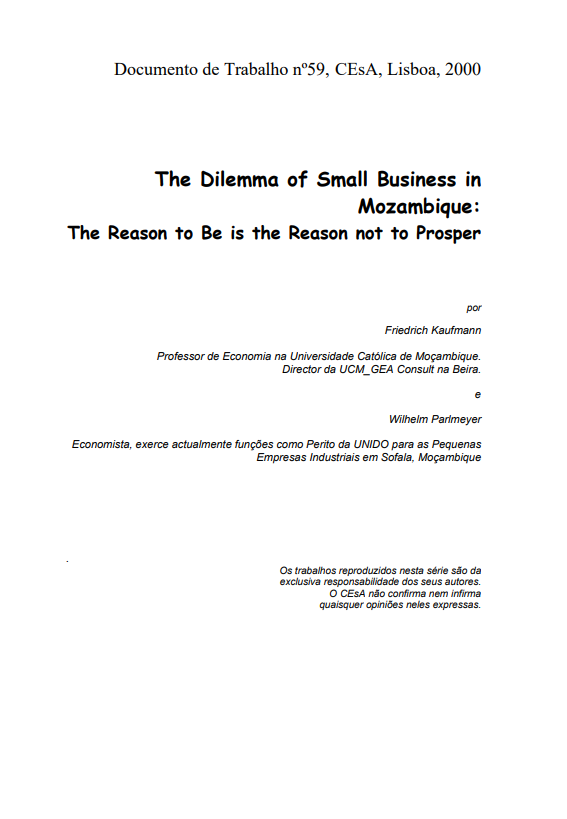
Working Paper 59/2000: The dilemma of a small business in Mozambique: the reason to be is the reason not to prosper
Abstract:
Running a small business in Mozambique, even in the presence of assistance from NGO’s like PAPIR, is a highly risky activity. Many firms from our sample have already closed down and the performance of many small firms has, in the last year, been quite poor. Most of these firms are very labour-intensive and don’t have access to energy or a stable working place. The growing competition is a problem, although there are positive aspects to it from the consumers’ point ofview. One of the main problems of Mozambican small businesses is that they have some characteristics on which, on the one hand, they depend to survive, but which, on the other hand, make it impossible – or at least difficult – for them to prosper and grow. Most small businesses are informal, unregistered, have no bank account and are usually temporary activities. They help to diversify the family income and are organised in local circuits. The first part of this text provides a review of the literature on small businesses in Africa, particularly in Mozambique, namely its characteristics and possible reasons to be. The second part highlights the results of several interviews with small-business entrepreneurs in Sofala/Mozambique.
Quotation:
Kaufmann, Friedrich e Wilhelm Parlmeyer. 2000. “The dilemma of a small business in Mozambique: the reason to be is the reason not to prosper”. Instituto Superior de Economia e Gestão. CEsA – Documentos de Trabalho nº 59/ 2000.