Working Papers
For submission of articles or Working Papers to CEsA, please send an email to:
comunicacao@cesa.iseg.ulisboa.pt
Working Paper 132/2015: Colonialismo e história
Abstract:
In Colonialismo e história we reflect on how today, in the field of world historical reflection, we are witnessing the vehemence of the reappearance of the colonial phenomenon, which has been imposing itself not only because of its nature as a ‘minority issue’, but also for the double fact that, on the one hand, it allows for rethinking in terms ‘ post-colonials’, the national identities of the colonizers and the colonized, whose emancipation went through the recovery of their own history, the affirmation of their historical identity and the preservation of their memory, and on the other hand, demanding a greater interrogative density about the politicization and the internal ideologization of History. Reflecting on the importance of the ‘democratization’ introduced by contemporary history on the stage of History, Pierre Nora (Rendez-vous de l’Histoire, 2011) highlights an evidence: world history, which is rooted in Eurocentrism, registers the tight bond between Europe /West and History, in a movement similar to the one that establishes the deep relationship between Nation and History, imposes the study of the colonial phenomenon, increasingly considered as a structuring nucleus of the processes of construction of History, of (also) Western national histories. If the articulation between History and Ideology records the way in which the history of the West or ‘Western-style’ history was the object of political and ideological manipulation, it also shows how the histories of European nations were organized and became the central axis from from which the rest of History and the World was stratified. But the study of colonialism, which highlights the hegemonic nature of the West, giving an account of the inevitability of the ideologization of the fabrication of History, reveals today the need to review the simple inscription of colonialism in the great register of national history, rewriting it in the light of the colonial phenomenon. The renewal of Portuguese historiography, from the 1840s onwards, in the wake of “the most advanced European historiographies of the time, gave rise to “a new protagonist and identity referent, the nation” (Matos, 2013) that was built based on the idea of a European racial/physical, intellectual and cultural superiority and in the organization of projects and practices, which established the scientific-cultural ingredients that allowed, in the 20th century, to materialize the hierarchy and domination of the world. Writing today about the relationship between Portuguese historiography and the colonial phenomenon that markedly marked national history in the last two centuries represents a complex task where silence and discomfort, political and ideological manipulations, documentary distortions and conceptual weaknesses intersect, which require work arduous and critical process of reorganizing a past marked by multiple prejudices, whose signs remain inscribed in contemporary Portugal.
Quotation:
Henriques, Isabel Castro .2015. “Colonialismo e história”. Instituto Superior de Economia e Gestão. CEsA – Documentos de Trabalho nº 132/2015
Working Paper 130/2014: Reshaping EU development policy: collective choices & the new global order
Abstract:
The European Union (EU) has built its development policy largely on the discourse of moral responsibility and solidarity (European Commission, European Parliament & European Council, 2006). This discourse is centred on the idea of a normative or ethical power, which shifts its role in the world from a positive model to a proactive promoter of ‘global public goods’. The recurrent focus of the EU is on poverty reduction and social issues, which sustains a self-portrayal as a guardian of the interests of the poor. This development policy is backed by strong financial resources and an implementation bureaucracy based in Brussels and EU delegations around the world. The EU is one of the world’s leading donors of official development assistance (ODA) to give it a strong weight in the relationship with recipient partner countries, in particular those that depend on it most. Beyond the material weight of its funding, the EU has maintained historical ties and influence in diplomatic, political and economic terms in many of its ODA recipient partner countries (especially in sub-Saharan Africa). Since the 2000s, EU development policy has not only undergone major structural changes in its institutional framework, but has also come to face a new international aid landscape. Reshaping EU development policy : collective choices & the new global order explores why a rules-based EU development policy is being challenged by reformed EU institutions and a new global order and how the EU is trying to respond to this context in the face of the deepest EU recession since the end of World War II.
Quotation:
Mah, Luís. 2014. “Reshaping EU development policy : collective choices & the new global order”. Instituto Superior de Economia e Gestão. CEsA – Documentos de Trabalho nº 130/2014.
Working Paper 129/2014: The role of special economic zones in african countries development and the chinese FDI
Abstract:
In The role of special economic zones in african countries development and the chinese FDI we comment how the Chinese Government’s policy of “going out” encourages Chinese companies to pay more attention to invest in the new markets, like Latin America, especially Africa. It promotes the establishment of more and more Chinese overseas industrial and trade zones. They not only help increase demand for Chinese-made machinery and equipment, reduce investment entry and operating costs, but also assist China’s efforts to boost industrial restructuring at home and nurture companies to move up the value chain. They also provide a stage for less experienced small and medium-sized enterprises (SMEs) overseas. For the African countries, they can learn from the experience and lessons from the Special Economic Zones (SEZs)established in China. The SEZs have proved to be particularly relevant for Chinese development in the past 35 years, since they were created in 1979, they played a decisive role for development of places like Shenzhen, Zhuhai, Xiamen, Shantou, Hainan and Shanghai.
Quotation:
Hao Zhang e Fernanda Ilhéu. 2014. “The role of special economic zones in african countries development and the chinese FDI”. Instituto Superior de Economia e Gestão. CEsA – Documentos de Trabalho nº 129/2014
Working Paper 128/2014: Política e segurança: desafios aos fundamentos do estado democrático e visões globais da segurança para o século XXI
Abstract:
In Política e segurança: desafios aos fundamentos do estado democrático e visões globais da segurança para o século XXI we discuss how the theme of Security, the first purpose of the State, is inseparable from democracy and freedom, and is crucial insofar as it is a design of men (who love freedom) and refers to the care with the very conservation of the State, as well as the well-being of its citizens and assets, regardless of the country and the circumstances in which they live. It is still the desire to get out of that miserable condition of war that is the necessary consequence of the natural passions of men, when there is no visible power capable of keeping them in respect, forcing them, for fear of punishment, to fulfill their pacts and respect for those laws, as Thomas Hobbes had taught in his masterful Leviathan. Therefore, the State has the obligation to regulate the political relationship with the different ways of understanding uncertainty, risk and conflict and, in the limit, the violence itself within the polis, which limits freedom itself, foundation of the rule of law. . It is this intimate circular relationship between security, democracy and freedom in liberal democracies that imposes such pressure on the State apparatus, especially in the bodies whose function and competence is the security of the State (in its internal and external aspects), which forces it to to recognize the impotence of its traditional supremacy.
Quotation:
Matos, Rui Paula de .2014. “Política e segurança: desafios aos fundamentos do estado democrático e visões globais da segurança para o século XXI”. Instituto Superior de Economia e Gestão. CEsA – Documentos de Trabalho nº 128/2014.
Working Paper 127/2014: Agricultura familiar em Moçambique: ideologias e políticas
Abstract:
Many African governments have welcomed these initiatives with enthusiasm, in the expectation of capital inflows and the creation of agrarian capitalism, in many cases benefiting their elites. Internally, various strategies have been adopted without the essential functions of agriculture in developing economies (especially in Africa) being guaranteed. These realities are, however, more pronounced in countries rich in natural resources, where there have been political and social conflicts, higher levels of social inequality to the detriment of rural areas and peasants, greater rural exodus and growing food deficits. The “unfriendly” policies of agriculture and small producers and the urban bias policies aggravate the long-lasting crisis of African and Mozambican agriculture. Agricultura familiar em Moçambique : ideologias e políticas addresses the marginalisation/resistance/integration of peasants in Mozambique in different political and economic contexts according to the recent history of the country. It shows how marginalisation occurs, with emphasis on policies and options in the context of the development models experienced. It verifies to what extent, and in what sense, structural transformations have taken place in agriculture within the general framework of development. Finally, the text seeks to identify and explain whether the incongruities between the discourse and practice of agrarian and economic policies are associated with ideologies and economic alliances for the benefit of local elites.
Quotation:
Mosca, João (2014). “Agricultura familiar em Moçambique : ideologias e políticas”. Instituto Superior de Economia e Gestão – CEsA Documentos de Trabalho nº 127-2014
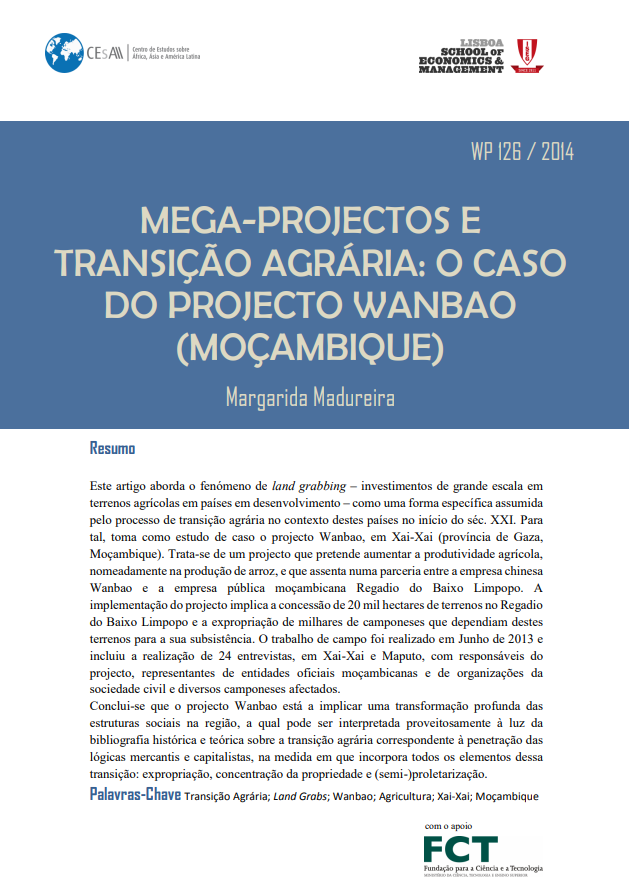
Working Paper 126/2014: Mega-projectos e transição agrária: o caso do projecto Wanbao (Moçambique)
Abstract:
Mega-projectos e transição agrária: o caso do projecto Wanbao (Moçambique) addresses the phenomenon of ‘land grabbing’ – large scale investments in agriculture in developing countries – as a particular form taken by the process of agrarian transition in the context of these countries in the beginning of the 21st Century. For this purpose, the Wanbao project in Xai-Xai (Gaza province, Mozambique) is used as a case study. The Wanbao project aims at increasing agricultural productivity, namely in rice production, and it builds on a partnership between the Chinese private company Wanbao and the Mozambican state company Regadio do Baixo Limpopo. The implementation of the project implies both the concession of 20 thousand hectares in the Regadio do Baixo Limpopo area and the expropriation of thousands of peasants who relied on these lands for their subsistence. Fieldwork was undertaken in June 2013 and included 24 interviews, in Xai-Xai and Maputo, with project managers, representatives of the Mozambican authorities and civil society organizations, as well as several affected peasants. We conclude that the Wanbao project is bringing about a profound transformation of the region’s social structures which can be usefully interpreted under the light of the historical and theoretical literature on the agrarian transition corresponding to the penetration of mercantile and capitalist logics – insofar as this process exhibits all the elements of that transition: expropriation; consolidation of land holdings; and (semi) proletarianization.
Quotation:
Madureira, Margarida (2014). “Mega-projectos e transição agrária: o caso do projecto Wanbao (Moçambique)”. Instituto Superior de Economia e Gestão. CEsA – Documentos de Trabalho nº 126/2014
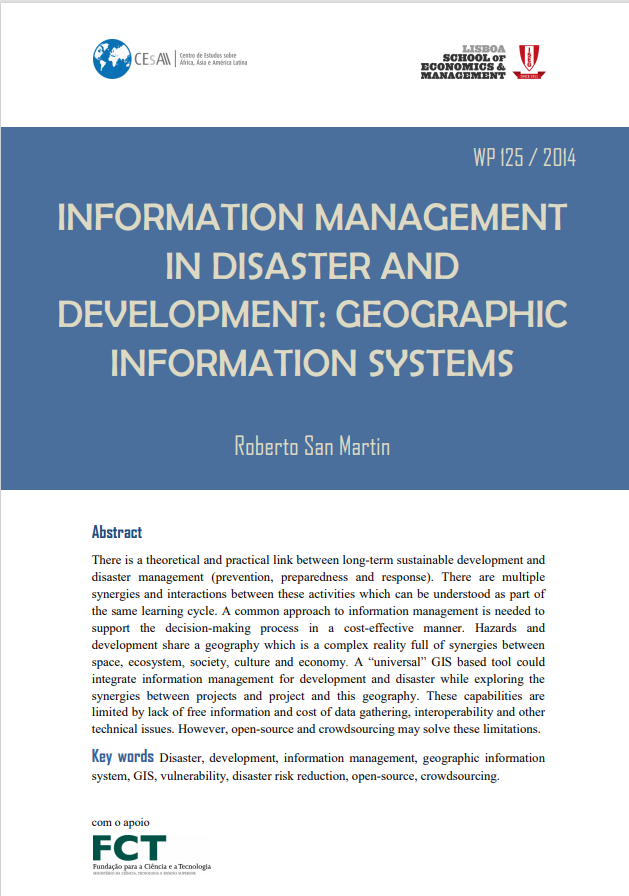
Working Paper 125/2014: Information management in disaster and development: geographic information systems
Abstract:
Information management in disaster and development : geographic information systems considers the information management concept within disaster management (prevention/mitigation, preparedness and response) and long-term sustainable development (planning, monitoring and evaluation). Disaster management and development have synergies and requirements which can be addressed within a common approach. Both require management of structured information, accurate, easily accessed, displayed and updated. There is a theoretical and practical link between long-term sustainable development and disaster management (prevention, preparedness and response). There are multiple synergies and interactions between these activities which can be understood as part of the same learning cycle. A common approach to information management is needed to support the decision-making process in a cost-effective manner. Hazards and development share a geography which is a complex reality full of synergies between space, ecosystem, society, culture and economy. A “universal” GIS based tool could integrate information management for development and disaster while exploring the synergies between projects and project and this geography. These capabilities are limited by lack of free information and cost of data gathering, interoperability and other technical issues. However, open-source and crowdsourcing may solve these limitations.
Quotation:
San Martin, Roberto. 2014. “Information management in disaster and development : geographic information systems”. Instituto Superior de Economia e Gestão. CEsA – Documentos de Trabalho nº 125/2014.
Working Paper 124/2014: Justiça ambiental e movimentos sociais. Reflexão teórica a partir de reconceiving environmental justice: global movements and political theorie de David Schlosberg
Abstract:
The purpose of Justiça ambiental e movimentos sociais. Reflexão teórica a partir de ‘Reconceiving environmental justice: global movements and political theory’ de David Schlosberg, within the course ‘Problematics in International Relations’ of the PhD in International Relations, is to understand to what extent the theorizations of social justice within political theory and environmental claims articulate with a view to the development of a definition of environmental justice at the global level. On the basis of John Rawls’ theorization of social justice, discussed by David Schlosberg in his essay Reconceiving Environmental Justice: Global Movements and Political Theories, we intend to argue that the inadequacy of theories of environmental justice is due to the failure to consider issues of respect, recognition and community political participation in their conceptualization. Schlosberg (2004), from an essay on the theorizations of justice and their articulation with the demands of environmental social movements, questions how the demands of these movements for greater environmental justice, especially those that articulate environmental concerns with certain forms of globalization in their arguments, contribute to the development of a definition of environmental justice at the global level.
Quotation:
Lima, Redy Wilson (2014). “Justiça ambiental e movimentos sociais. Reflexão teórica a partir de Reconceiving environmental justice: global movements and political theory’ de David Schlosberg”. Instituto Superior de Economia e Gestão. CEsA – Documentos de Trabalho nº 124/2014.
Working Paper 123/2014: Economia informal e políticas em Moçambique: lógicas e práticas dos Mukheristas
Abstract:
The informal sector in Mozambique is a source of employment and survival resources for most of the population. Mostly dominated by women, it is through this sector that some social mobility of urban populations can be observed, guaranteeing education, health and even leisure for their families. Economia informal e políticas em Moçambique : lógicas e práticas dos Mukheristas discusses the relationship between policies and the informal economy in Mozambique, specifically focusing on the logics and practices of the mukheristas, informal micro-importers operating in the city of Maputo. The analysis is based on two theoretical assumptions, namely: the diverse rationality presented by Hugon (1999, 2000) and the theory of reasoned action by Fishbein and Ajzen (2010). The central question of the work is: what perceptions of wealth and poverty derive from the practice of mukhero? Two of the main conclusions of the text are: (1) the mukhero makes it possible to reduce poverty and generate wealth, both to a limited extent; (2) top policy makers may be deliberately encouraging the informal economy as a strategy to ensure control of the small formal sector from which they derive dividends at the expense of society as a whole.
Quotation:
Chivangue, Andes .2014. “Economia informal e políticas em Moçambique : lógicas e práticas dos Mukheristas”. Instituto Superior de Economia e Gestão. CEsA – Documentos de Trabalho nº 123/2014.
Working Paper 122/2013: Abertura ao exterior: uma inevitabilidade para as pequenas economias insulares e condição essencial para o desenvolvimento sustentável de S. Tomé e Príncipe
Abstract:
Abertura ao exterior : uma inevitabilidade para as pequenas economias insulares e condição essencial para o desenvolvimento sustentável de S. Tomé e Príncipe discusses, very briefly, why small island economies are pressured to open up to the outside and what are the conditions under which they must guide their process of sustainable development. In particular, the text discusses what should be the external orientation of the economy of São Tomé and Príncipe for its internationalization in the current context of the world economy. Given the structural characteristics of the economy of S. Tomé and Príncipe, namely the persistence of a declining productive sector, very fragile economic, political and social institutions, and an endowment of human resources with important limitations, the opening to the outside must be considered as crucial for promoting their development. Furthermore, this country depends exclusively on external flows for its survival. Thus, such openness is essential insofar as it constitutes an incentive for foreign direct investment, which is fundamental for the financing of wealth-producing activities with a view to the sustainable reduction of unemployment and poverty. Greater opening to the outside will tend to progressively increase foreign direct investment and foreign aid, which constitute an important factor, if not the only one at the moment, for the insertion of São Tomé and Príncipe in the current globalized world economy. In order for such openness to contribute to its development, it is proposed that it should be conducted on the basis of economic strategies congruent with the specificity of small island economies. That is, that the selected economic activities suit the small size and isolation of the territory in order to circumvent the negative effects of diseconomies of scale. But also political stability, good governance and valorization of human resources are essential.
Quotation:
Santo, Armindo Espírito. 2013. “Abertura ao exterior : uma inevitabilidade para as pequenas economias insulares e condição essencial para o desenvolvimento sustentável de S. Tomé e Príncipe”. Instituto Superior de Economia e Gestão. CEsA – Documentos de Trabalho nº 122/2013.