Development Economics and Policy
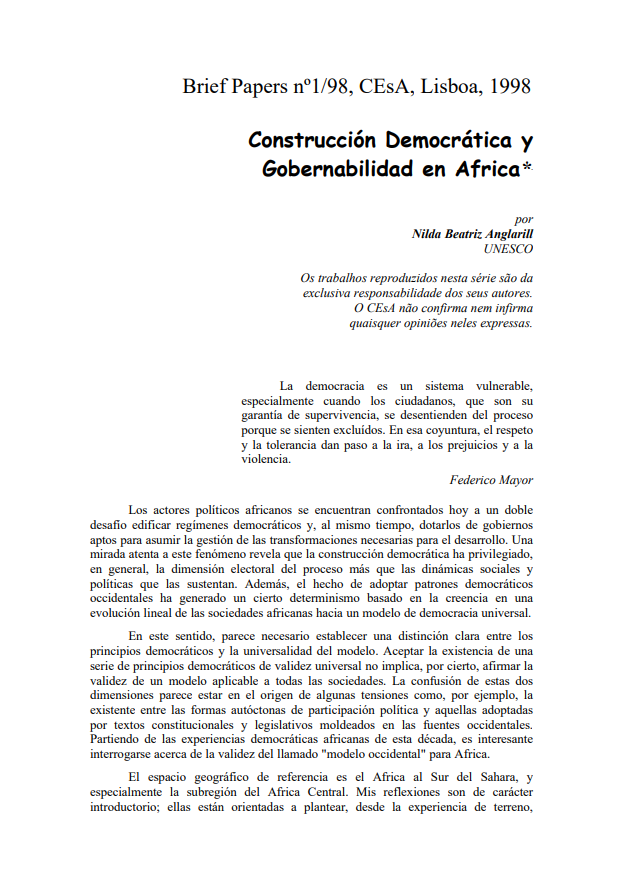
Brief Paper 1/1998: Construccíón Democrática y Gobernabilidad en Africa
Abstract:
African political players are today faced with a double challenge: building democratic regimes and, at the same time, equipping them with governments capable of managing the transformations necessary for development. A close look at this phenomenon reveals that democracy building has generally privileged the electoral dimension of the process rather than the underlying social and political dynamics. Moreover, the adoption of Western democratic standards has generated a certain determinism based on the belief in a linear evolution of African societies towards a model of universal democracy. In this sense, it seems necessary to make a clear distinction between democratic principles and the universality of the model. Accepting the existence of a series of democratic principles of unequivocal validity does not, of course, imply the affirmation of the validity of a model applicable to all societies. Confusion between these two dimensions seems to be at the root of certain tensions, such as that between indigenous forms of political participation and those adopted by constitutional and legislative texts based on Western sources. On the basis of the African democratic experiences of this decade, it is interesting to question the validity of the so-called “Western model” for Africa. Communication at the CESA 1997 Seminar: The Problematic of Development – History and a Transdiciplinary Perspective, Conference Construção Democrática e Contributos Actuais numa Governance em África (Democratic Construction and Current Contributions to Governance in Africa), 23 May 1997.
Quotation:
Comunicação no Seminário CEsA 1997: A Problemática do Desenvolvimento – Historicidade e Contributos Actuais numa Óptica Transdiciplinar, Conferência “Construção Democrática e ‘Governance’ em África”, 23 de Maio de 1997.
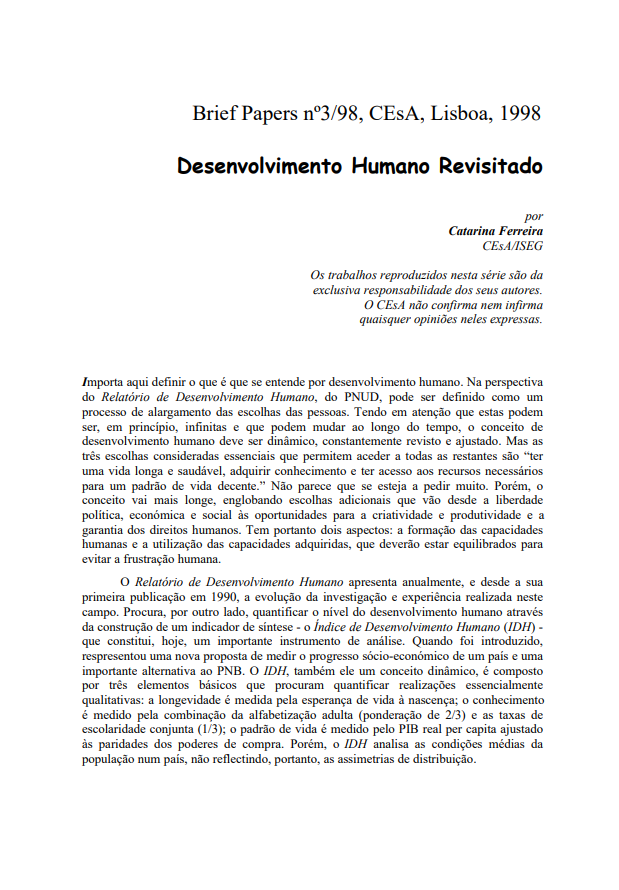
Brief Paper 3/1998: Desenvolvimento Humano Revisitado
Abstract:
Every year since it was first published in 1990, the Human Development Report presents the evolution of research and experience in this field. It also seeks to quantify the level of human development by constructing a synthesis indicator – the Human Development Index (HDI) – which is now an important tool for analysis. When it was introduced, it represented a new proposal to measure the socio-economic progress of a country and an important alternative to the GNP. The HDI, itself a dynamic concept, is made up of three basic elements which seek to quantify essentially qualitative achievements: longevity is measured by life expectancy at birth; knowledge is measured by combining adult literacy (weighting 2/3) and joint schooling rates (1/3); standard of living is measured by real GDP per capita adjusted for purchasing power parities. However, the HDI analyses the average conditions of the population in a country and does not therefore reflect distributional asymmetries. A first version of Desenvolvimento humano revisitado was prepared for Projecfo ED/96/02 Decentralised Cooperation, Fight against Exclusion and Human Development in Portugal, Italy and Belgium, an EC project being prepared by three European NGOs: ACEP – Portugal, Ricerca e Coopcrazione – Italy and ITECO – Belgium.
Quotation:
Ferreira, Catarina. 1998. “Desenvolvimento humano revisitado”. Instituto Superior de Economia e Gestão – CEsA Brief papers nº 3-1998.
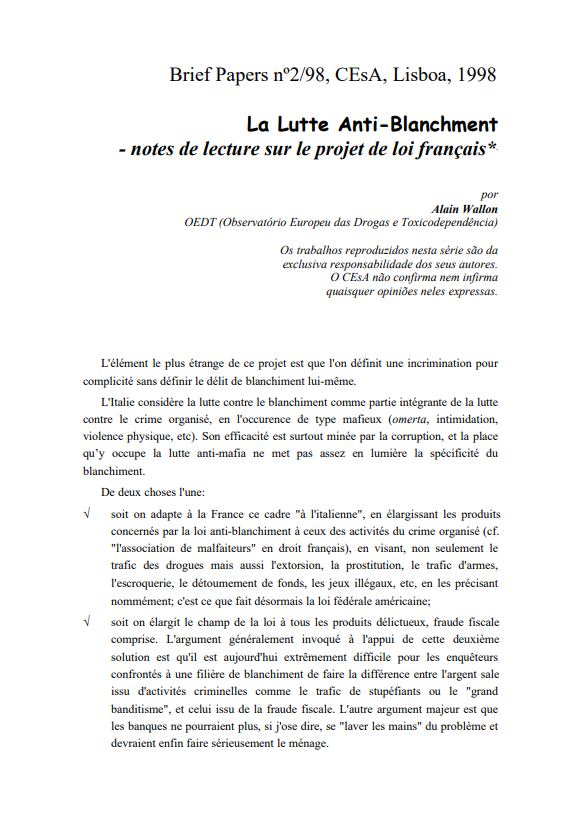
Brief Paper 2/1998: La Lutte Anti-blanchment: Notes de lecture sur le project de loi français
Abstract:
The strangest thing about this draft is that it defines an incrimination for aiding and abetting without defining the offence of money laundering itself. Italy considers the fight against money laundering to be an integral part of the fight against organised crime, in this case of the mafia type (omertà, intimidation, physical violence, etc.). Its effectiveness is mainly undermined by corruption, and the place of the fight against the mafia does not sufficiently highlight the specific nature of money laundering. The tax weapon should not be forgotten. It brought Capone down. It will still be necessary to ensure that the determination to pursue the ordinary citizen in France, sometimes arbitrarily, is transformed with equal efficiency against organised crime. Finally, the participation of banks in the process of defining new rules seems indispensable. La lutte anti-blanchment: notes de lecture sur le project de loi français served as a basis for the lecture “Mundialização, Drogas e Sistema Financeiro” (Globalisation, Drugs and the Financial System) given by Prof. Alain Wallon on 17 March as part of the Master’s in International Development and Cooperation, at the invitation of Prof. René Tapia Ormázabal, in the subject of Financial Systems and Development Finance.
Quotation:
Wallon, Alain. 1998. “La lutte anti-blanchment: notes de lecture sur le project de loi français”. Instituto Superior de Economia e Gestão – CEsA Brief papers nº 2-1998.
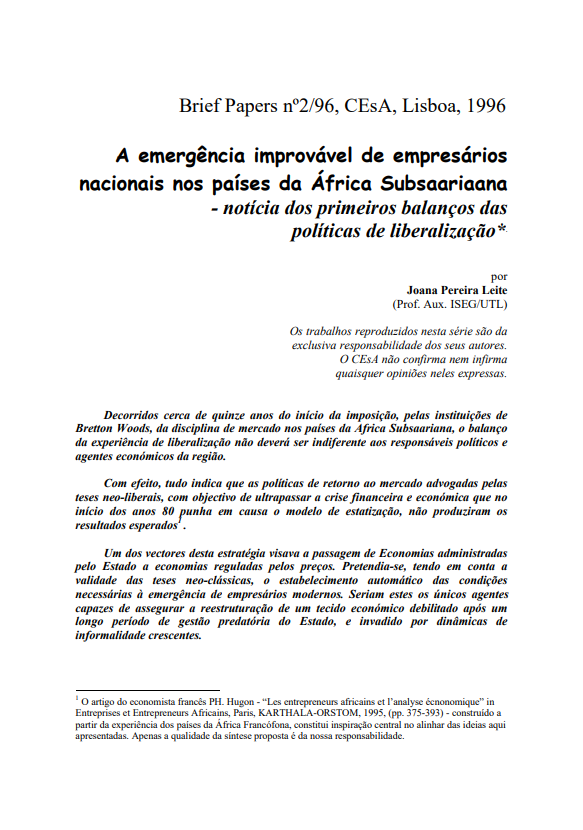
Brief Paper 2/1996: A Emergência Improvável de Empresários Nacionais nos Países da África Subsaariaana: Notícia dos primeiros balanços das políticas de liberalização
Abstract:
About fifteen years after the Bretton Woods institutions started imposing market discipline on the countries of Sub-Saharan Africa, the assessment of the liberalisation experience should not be indifferent to political leaders and economic players in the region. In fact, everything indicates that the policies of return to the market advocated by the neo-liberal theses, with the aim of overcoming the financial and economic crisis which, at the beginning of the 1980s, called the nationalisation model into question, did not produce the expected results. One of the vectors of this strategy was the transition from state-managed economies to price-regulated economies. Taking into account the validity of the neoclassical theses, the aim was the automatic establishment of the necessary conditions for the emergence of modern entrepreneurs. These would be the only agents capable of ensuring the restructuring of a weakened economic fabric after a long period of predatory management by the state, and invaded by growing dynamics of informality. A emergência improvável de empresários nacionais nos países da África Subsaariaana: notícia dos primeiros balanços das políticas de liberalização is not intended to recall the “formal/informal” debate, so dear to the economic literature of the last two decades. Bearing in mind the extreme economic complexity of African societies, the aim is simply to highlight some relevant, though not always evident, aspects of recent reflection on the difficult emergence of the African business class in the context of adjustment policies.
Quotation:
Leite, Joana Pereira. 1996. “A emergência improvável de empresários nacionais nos países da África Subsaariaana : notícia dos primeiros balanços das políticas de liberalização”. Instituto Superior de Economia e Gestão – CEsA Brief papers nº 2-1996

Brief Paper 1/1996: As Fronteiras em África: Contributo para uma reflexão crítica
Abstract:
The role played by political borders in Africa (predominantly inherited from the colonial period) has merited some critical reflections by some authors, both in terms of their role in the construction of the new states and in terms of their impact and consequences in the lives of the populations of the cross-border regions. In As fronteiras em África: contributo para uma reflexão crítica we have two texts, by Daniel Bach and Emmanuel Grégoire, from which short extracts are presented. First, however, a necessarily succinct exposition of their respective theses: For Daniel Bach, Regionalisation tends to be done not by dismantling the barriers that constitute borders, but by taking advantage of the business opportunities originated by these very borders. A second thesis of Bach is that the Structural Adjustment Programmes, by reducing fiscal or customs differences between states, tend to transfer to the external borders of the continent those same business opportunities or the search for them…) and thus accelerate the criminalisation of flows. A first question arises here: the nature of this “regionalisation” of which Daniel Bach speaks, and the text of this author which we quoted above is as follows: “Transstate flows and circuits exercise functions of social regulation and accumulation which are vital for populations faced with the disintegration of official circuits and the regression of the territorial framework of the state”. As for Grégoire, the text offered for our reflection here is taken from a historical and anthropological account of a phenomenon which at first sight is predominantly economic and has the suggestive title: “The Smuggling Paths “Far from being an obstacle to trade, the border which has separated the Hausa country for over twenty years is, on the contrary, a stimulus… On an economic level, its dynamic effects outweigh the negative effects…”.
Quotation:
Statter, Guilherme da Fonseca. 1996. “As fronteiras em África: contributo para uma reflexão crítica”. Instituto Superior de Economia e Gestão – CEsA Brief papers nº 1-1996.
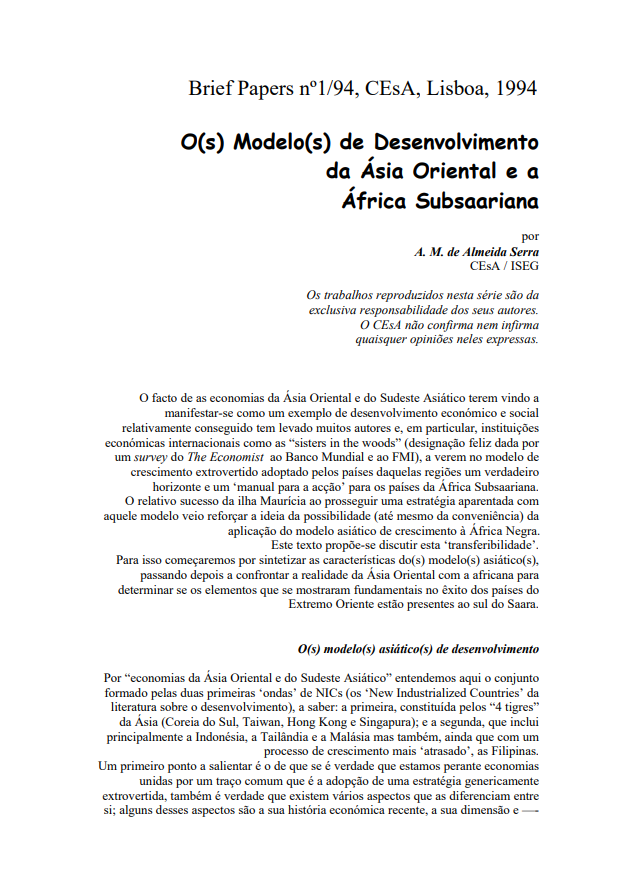
Brief Paper 1/1994: O(s) Modelo(s) de Desenvolvimento da Ásia Oriental e a África Subsaariana
Abstract:
The fact that the economies of East Asia and Southeast Asia have emerged as an example of relatively successful economic and social development has led many authors and, in particular, international economic institutions such as the “sisters in the woods” (the felicitous name given to the World Bank and the IMF by a survey in The Economist), to see the model of extroverted growth adopted by the countries of those regions as a real horizon and “manual for action” for the countries of Sub-Saharan Africa. The relative success of Mauritius in pursuing a strategy similar to this model has reinforced the idea that it is possible (and even desirable) to apply the Asian growth model to Black Africa. O(s) modelo(s) de desenvolvimento da Ásia Oriental e a África Subsaariana aims to discuss this “transferability”. To this end, we shall begin by summarising the characteristics of the Asian model(s), and then move on to confront the East Asian reality with that of Africa in order to determine whether the elements that proved fundamental to the success of the Far Eastern countries are present to the south of the Sahara.
Quotation:
Serra, António M. de Almeida. 1994. “O(s) modelo(s) de desenvolvimento da Ásia Oriental e a África Subsaariana”. Instituto Superior de Economia e Gestão – CEsA Brief papers nº 1-1994.
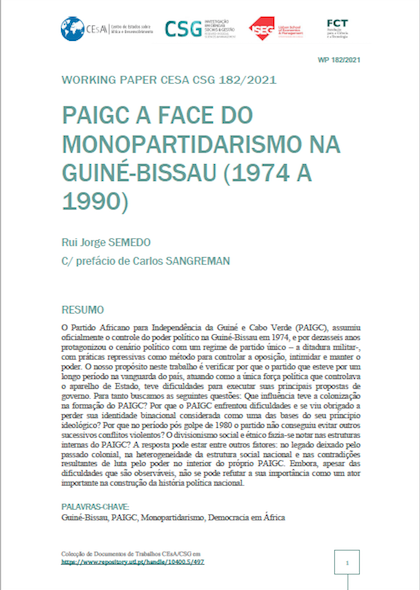
Working Paper 182/2021: PAIGC a Face do Monopartidarismo na Guiné-Bissau (1974 a 1990)
Abstract:
The African Party for Independence of Guinea and Cape Verde (PAIGC) officially took control of political power in Guinea-Bissau in 1974, and for sixteen years has starred in the political scene with a single-party regime – a military dictatorship–with repressive practices as a method to control the opposition, intimidate and maintain power. Our purpose in PAIGC a face do monopartidarismo na Guiné-Bissau (1974 a 1990) is to verify why the party that was for a long time at the forefront of the country, acting as the only political force that controlled the state apparatus, had difficulty executing its main government proposals. For this we seek the following questions: What influence did colonization have on the formation of the PAIGC? Why did the PAIGC face difficulties and were forced to lose its binational identity considered as one of the bases of its ideological beginning? Why in the post-coup period of 1980 could the party not prevent other successive violent conflicts? Was social and ethnic divisionism noted in the internal structures of the PAIGC? The answer may be among other factors: in the legacy left by the colonial past, in the heterogeneity of the national social structure and in the contradictions resulting from the struggle for power within the PAIGC itself. Although, despite the difficulties that are observable, it cannot be refuted its importance as an important player in the construction of national political history.
Quotation:
Semedo, Rui Jorge (2021). “PAIGC a face do monopartidarismo na Guiné-Bissau (1974 a 1990)”. Instituto Superior de Economia e Gestão – CEsA/CSG – Documentos de Trabalho nº 182/2021.
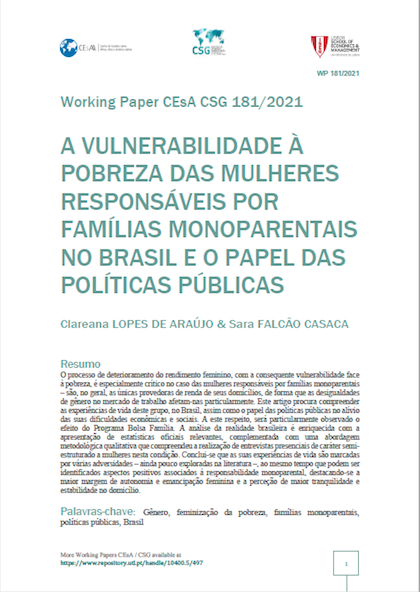
Working Paper 181/2021: A Vulnerabilidade à Pobreza das Mulheres Responsáveis por Famílias Monoparentais no Brasil e o Papel das Políticas Públicas
Abstract:
The deterioration of women’s income, and their consequent vulnerability to poverty, is particularly critical in the case of women who are the head of single-parent families – being them the only provider to the household, gender inequalities in the labor market affect them more significantly. A Vulnerabilidade à Pobreza das Mulheres Responsáveis por Famílias Monoparentais no Brasil e o Papel das Políticas Públicas seeks to understand the life experiences of these women, in Brazil, as well as the role of the State in alleviating their economic and social difficulties, where the effect of the Bolsa Família Programme will be studied in particular. The analysis of the Brazilian reality is enhanced by the presentation of relevant official statistics, complemented by a qualitative methodological approach based on semi-structured interviews conducted with women in this situation. It is concluded that their life experiences are affected by several hardships that are still relatively under-researched, but also by positive aspects related to their condition as single parents, above all in terms of their autonomy and perception of greater emancipation, as well as living in a safe and emotionaly stable environment.
Quotation:
Araújo, Clareana Lopes de e Sara Falcão Casaca (2021). “A vulnerabilidade à pobreza das mulheres responsáveis por famílias monoparentais no Brasil e o papel das políticas públicas”. Instituto Superior de Economia e Gestão – CEsA/ CSG – Documentos de Trabalho nº 181/2021.
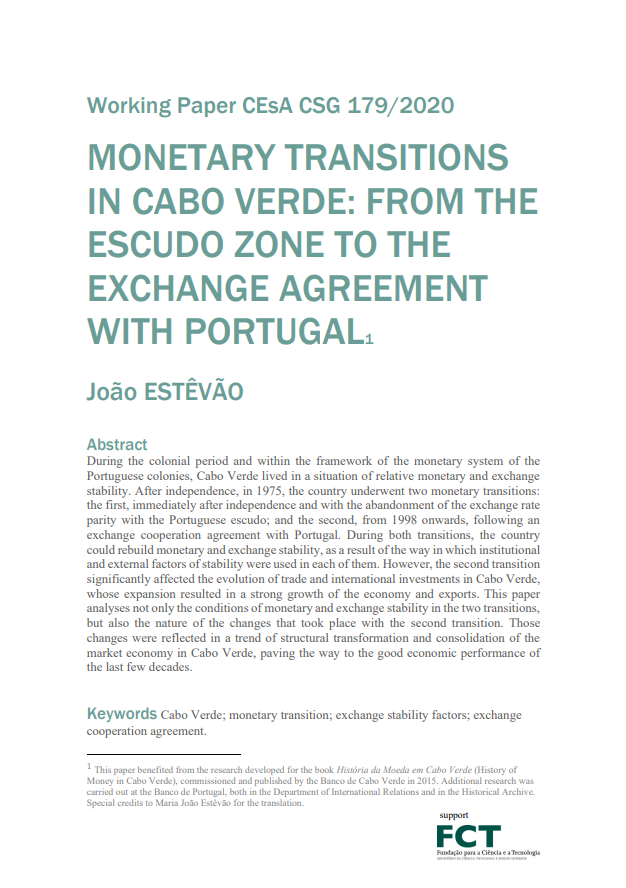
Working Paper 179/2020: Monetary Transitions in Cabo Verde: From the escudo zone to the exchange agreement with Portugal
Abstract:
Monetary Transitions in Cabo Verde: From the escudo zone to the exchange agreement with Portugal studies how, during the colonial period and within the framework of the monetary system of the Portuguese colonies, Cape Verde lived in a situation of relative monetary and exchange rate stability. After independence in 1975, the country underwent two monetary transitions: the first, immediately after independence and with the abandonment of parity with the Portuguese escudo; and the second, from 1998 onwards, following an exchange rate cooperation agreement with Portugal. During both transitions, the country was able to rebuild monetary and exchange rate stability, depending on how institutional and external stability factors were used in each of them. However, the second transition significantly affected the evolution of international trade and investment in Cape Verde, whose expansion resulted in strong growth in the economy and exports. This article analyses not only the conditions of monetary and exchange rate stability in the two transitions, but also the nature of the changes that occurred with the second transition. These changes translated into a trend of structural transformation and consolidation of the market economy in Cape Verde, paving the way for the good economic performance of recent decades.
Quotation:
Estêvão, João (2020). “Monetary transitions in Cabo Verde : from the escudo zone to the exchange agreement with Portugal”. Instituto Superior de Economia e Gestão – CEsA/ CSG – Documentos de Trabalho nº 179/2020.
Working Paper 173/2018: Women in Politics: Portugal as a case study
Abstract:
Democracy is about the power of the people. In order to sustain, implies (at least) representativeness of its major groups. When majority rules minorities, lobbies complain when not happy and some of their demands are met; but the system doesn’t turn totally in their favor if it goes against the interests of a larger assembly. When minority rules the majority, problems arise (populism against elite, for instance); and sooner or later there’s a significant shift in society. Quantity gives power. Numbers do count in Democracy. Women are the majority of the population. It was not always so, but nowadays it’s an unquestionable fact. For cultural, institutional or socioeconomic reasons they were submissive for centuries to a system that did not recognize their public activity. They were not involved in decision making and rebel against that. At first, their demands were not met. But waves are changing. As long as democracy prevails and women’s numbers and percentages won’t drop, they’ll probably continue to raise awareness to their cause, increasing their power and influence in society. The evolution of women’s empowerment is the focus of Women in Politics: Portugal as a case study, that tries to analyze the main characteristics, causes and effects of this process, based on theory and world references or statistics. Portugal was chosen as a case study for not being much researched or not sufficiently so far.
Quotation:
Galito, Maria Sousa (2018). “Women in politics : Portugal as a case study”. Instituto Superior de Economia e Gestão – CEsA/ CSG – Documentos de Trabalho nº 173/2018.