Development Dynamics
Brief Paper 1/1999: Condicionantes Culturais e Históricas das Reformas Económicas Pós-crise Asiática: O caso da Coreia do Sul
Abstract:
In Condicionantes Culturais e Históricas das Reformas Económicas Pós-crise Asiática: O caso da Coreia do Sul, we focus on Confucianism (a philosophy still prevailing in Korea) and its influence in the management of companies. It is believed that this philosophy, together with historical conditions, has influenced certain economic practices in the country in recent times, with special emphasis on the period of the Asian economic crisis. An attempt is also made to investigate the limits of the current reforms dictated by the IMF on the basis of cultural issues. It also focuses on the relationship between Koreans and foreigners. Finally, it is believed that these factors have to be taken into consideration in a broader analysis of prospects and trends in the Korean economy. It is believed that in an economic or financial analysis of the Korean (and Asian) crisis, its consequences and the outcome of reforms it is indispensable to take into account cultural and historical factors and social specificities. Confucianism is the most influential of these features. Some points of its influence on economic decision-making are reviewed. Certain Confucian features are believed to act as catalysts for economic recovery, and should not be completely dismissed as anachronistic. Korea could become a model of development, combining, in an original way, such divine variables as Confucianism, globalisation and economic liberalisation, on condition that a certain rigour in administration is introduced. Finally, I am convinced that a Confucian society is not incompatible with economic and democratic development in an increasingly global environment.
Quotation:
Mota, Bernardo. 1999. “Condicionantes culturais e históricas das reformas económicas pós-crise asiática : o caso da Coreia do Sul”. Instituto Superior de Economia e Gestão – CEsA Brief papers nº 1-1999
Brief Paper 4/1998: Acordo de Cooperação Cambial entre Portugal e Cabo Verde
Abstract:
An Exchange Cooperation Agreement was recently signed between the Republics of Portugal and Cape Verde. This agreement, which had been under negotiation for some time, was presented by the two signatory countries as a corollary to the exemplary nature of Luso-Cape Verde relations, especially in the area of economic and financial cooperation, and as an instrument for strengthening bilateral economic ties, especially as regards the intensification of trade and investment flows. But it is also an important milestone in the framework of the CPLP, in the sense that its results may come to enhance other bilateral or multilateral agreements. The Agreement, signed in March this year, will only come into force within a maximum of three months from the date it is signed, by which time the Exchange Cooperation Agreement Commission, the entity responsible for defining and reviewing the operating conditions, as well as for managing the Agreement, should already be performing its duties. If the specific operating conditions are not yet known, which does not allow a more concrete analysis of its virtualities, however, the characteristics which define its philosophy may be identified in the text of the Agreement itself. A summary of Acordo de cooperação cambial entre Portugal e Cabo Verde (Agreement on Exchange Rate Co-operation between Portugal and Cape Verde), entitled Moeda une Portugal e Cabo Verde (Currency unites Portugal and Cape Verde), was published in Informação Lusófona (UCCLA), no. 6, April 1998, p. 2.
Quotation:
Estêvão, João. 1998. “Acordo de cooperação cambial entre Portugal e Cabo Verde”. Instituto Superior de Economia e Gestão – CEsA Brief papers nº 4-1998.
Working Paper 177/2019: Terrorismo na União Europeia
Abstract:
The European Union (EU) has suffered several violent attacks. Terrorismo na União Europeia investigates the conceptualisation of terrorism as a political phenomenon, differentiating it from other types of organised crime, in a context of regional threats, coming from the Mediterranean, jihadism and its consequences in the EU, without forgetting issues such as social exclusion related to the current migration crisis, autonomous claims within the regional bloc and the spread of populism. The EU Strategy for Combating Radicalisation and Recruitment to Terrorism is discussed. A critical analysis is made of the European Cybersecurity Strategy and the European Council’s New Strategic Agenda for 2019-2024 with regard to counter-terrorism. The idea is to confront legislative measures and to review precedents, within the framework of the Security Union and the Defence Union. The critical analysis of EU action is made on the basis of the challenges identified by the European Commission for the Community future, considering the Strategic Agenda 2019/2024, in a disruptive environment, in which the Community institutions have tried to be effective or even innovative and forerunners in terms of policy change.
Quotation:
Galito, Maria Sousa (2019). “Terrorismo na União Europeia”. Instituto Superior de Economia e Gestão – CEsA/CSG Documentos de Trabalho nº 177-2019.
Working Paper 175/2019: Sahel e Magreb: Ensaio sobre o Norte de África, uma região em convulsão
Abstract:
Sahel e Magreb : ensaio sobre o norte de África, uma região em convulsão focuses on the Sahel and on the Maghreb. The objective is to assess whether these regions are in crisis, with common problems affecting their countries; if there are specific characteristics limiting their development, and conflicts are justified by religious or economic issues, cultural patterns or local challenges. The study is macro. Debates the role of Fragile States with high violence, economic and social vulnerability, power struggles and fighting for natural resources. The paper is subdivided into two chapters. The first compares the Sahel and Maghreb regions, with a short analysis for each country that constitutes them, since the spaces are very related to each other, since traffickers transit along the trade routes of the ancient caravans of the desert caravans, or less watched over by law enforcement agents or controlled by guerrillas or or controlled by guerrilla or terrorist groups. Maps and statistical tables are offered for appropriate comparisons. The second chapter is about the influence of the Arab Spring in North Africa, with reference its main causes and consequences. Given that these states are considered fragile by the international community, the question is whether they are failures and why they have serious problems of governance, internal stability or the stability of their borders. It assesses the fight against terrorism, in a sensitive in a sensitive context where former guerrilla fighters are still active, part of militias or terrorist groups or claiming possession of natural resources, reclaiming for themselves the sources of income and the channels of distribution. sources of income and channels of distribution. Different types of violence or organised crime are also differentiated crimes.
Quotation:
Galito, Maria Sousa (2019). “Sahel e Magreb : ensaio sobre o norte de África, uma região em convulsão”. Instituto Superior de Economia e Gestão – CEsA/ CSG – Documentos de Trabalho nº 175/2019.
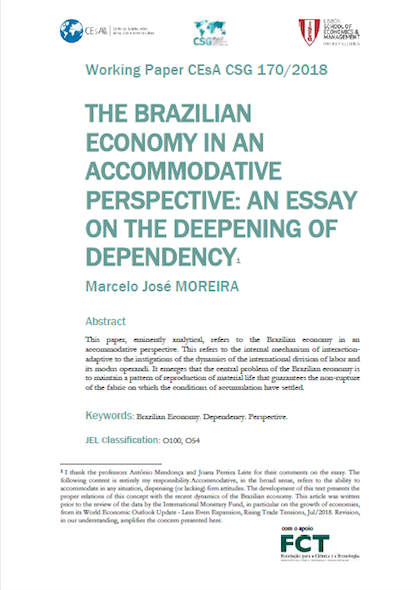
Working Paper 170/2018: The Brazilian Economy in an Accommodative Perspective: An essay on the deepening of dependency
Abstract:
This article, eminently analytical, refers to the brazilian economy in an accommodative perspective. This refers to the internal mechanism of interactionadaptive to the instigations of the dynamics of the international division of labor and its modus operandi. It emerges that the central problem of the Brazilian economy is to maintain a pattern of reproduction of material life that guarantees the non-rupture of the fabric on which the conditions of accumulation have settled. This document aims to propose a way of analyzing the Brazilian economy and its relationship with the recent dynamic of the global economy. In order to do so, one takes into account its dependence trajectory with this dynamics and proposes to analyze it in a perspective of non-structural alteration of the components that support it and, as a hypothesis, of the way these components interact. The components, for the purposes of this essay, are: exports and imports of goods (here called the Decisive Activity), reproduction of the labor force (here considered, as a proxy, for the joint analysis of the unemployment rate and average real income in minimum wages) and the investment rate (as a percentage of GDP).
Quotation:
Moreira, Marcelo José (2018). “The Brazilian Economy in an Accommodative Perspective: An essay on the deepening of dependency”. Instituto Superior de Economia e Gestão – CEsA /CSG – Documentos de Trabalho nº 170/2018.
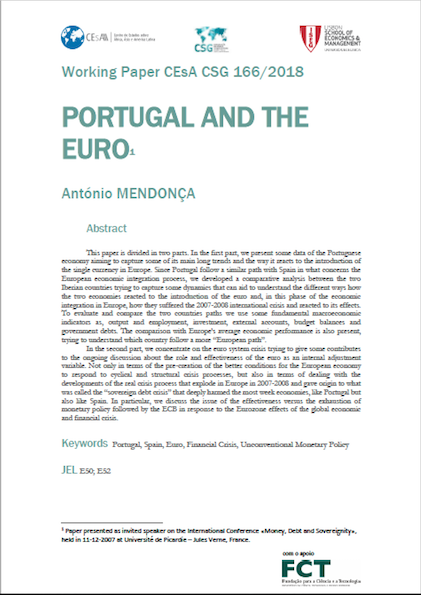
Working Paper 166/2018: Portugal and the Euro
Abstract:
Portugal and the Euro is divided in two parts. In the first part, we present some data of the Portuguese economy aiming to capture some of its main long trends and the way it reacts to the introduction of the single currency in Europe. Since Portugal follow a similar path with Spain in what concerns the European economic integration process, we developed a comparative analysis between the two Iberian countries trying to capture some dynamics that can aid to understand the different ways how the two economies reacted to the introduction of the euro and, in this phase of the economic integration in Europe, how they suffered the 2007-2008 international crisis and reacted to its effects. To evaluate and compare the two countries paths we use some fundamental macroeconomic indicators as, output and employment, investment, external accounts, budget balances and government debts. The comparison with Europe’s average economic performance is also present, trying to understand which country follow a more “European path”. In the second part, we concentrate on the euro system crisis trying to give some contributes to the ongoing discussion about the role and effectiveness of the euro as an internal adjustment variable. Not only in terms of the pre-creation of the better conditions for the European economy to respond to cyclical and structural crisis processes, but also in terms of dealing with the developments of the real crisis process that explode in Europe in 2007-2008 and gave origin to what was called the “sovereign debt crisis” that deeply harmed the most week economies, like Portugal but also like Spain. In particular, we discuss the issue of the effectiveness versus the exhaustion of monetary policy followed by the ECB in response to the Eurozone effects of the global economic and financial crisis.
Quotation:
Mendonça, António (2018). “Portugal and the Euro”. Instituto Superior de Economia e Gestão – CEsA/ CSG – Documentos de Trabalho nº 166/2018.
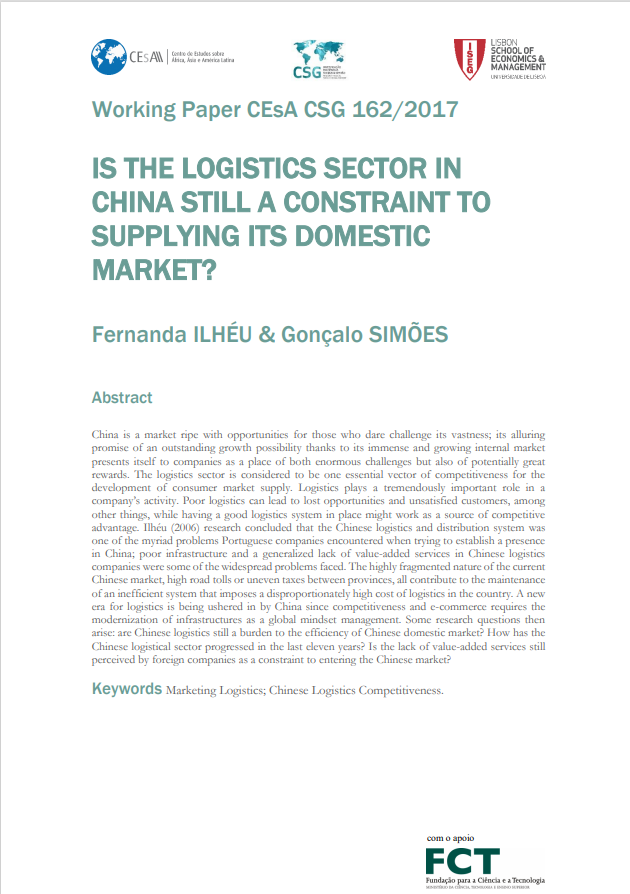
Working Paper 162/2017: Is the Logistics Sector in China Still a Constraint to Supplying its Domestic Market?
Abstract:
China is a market ripe with opportunities for those who dare challenge its vastness; its alluring promise of an outstanding growth possibility thanks to its immense and growing internal market presents itself to companies as a place of both enormous challenges but also of potentially great rewards. The logistics sector is considered to be one essential vector of competitiveness for the development of consumer market supply. Logistics plays a tremendously important role in a company’s activity. Poor logistics can lead to lost opportunities and unsatisfied customers, among other things, while having a good logistics system in place might work as a source of competitive advantage. In Is the Logistics Sector in China Still a Constraint to Supplying its Domestic Market? we continue the Ilhéu (2006) research that concluded that the Chinese logistics and distribution system was one of the myriad problems Portuguese companies encountered when trying to establish a presence in China; poor infrastructure and a generalized lack of value-added services in Chinese logistics companies were some of the widespread problems faced. The highly fragmented nature of the current Chinese market, high road tolls or uneven taxes between provinces, all contribute to the maintenance of an inefficient system that imposes a disproportionately high cost of logistics in the country. A new era for logistics is being ushered in by China since competitiveness and e-commerce requires the modernization of infrastructures as a global mindset management. Some research questions then arise: are Chinese logistics still a burden to the efficiency of Chinese domestic market? How has the Chinese logistical sector progressed in the last eleven years? Is the lack of value-added services still perceived by foreign companies as a constraint to entering the Chinese market?
Quotation:
Ilhéu, Fernanda e Gonçalo Simões (2017). “Is the Logistics Sector in China Still a Constraint to Supplying its Domestic Market?”. Instituto Superior de Economia e Gestão – CEsA/ CSG – Documentos de Trabalho nº 162/2017