Democracy
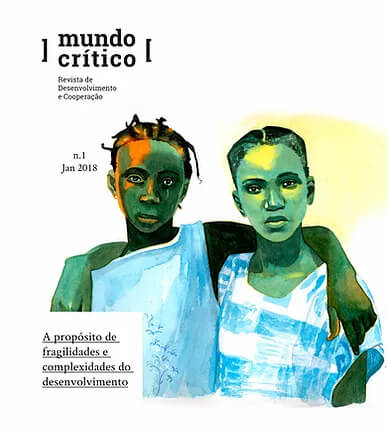
Mundo Crítico n.º 1: A propósito de fragilidades e complexidades do desenvolvimento
Abstract:
In an era of multiple challenges, spanning from the local to the global scale, Mundo Crítico – Journal of Development and Cooperation seeks to address the need for debate among public and private social actors, regardless of their size or geographic and thematic scope, with a critical, persistent, and dialogical commitment. It aims to foster unlikely dialogues between text and image, between art and science, between academics, artists, and practitioners, and among Portuguese-speaking individuals from diverse geographical and cultural spaces. The debate aspires to be comprehensive, with a particular focus on the ongoing social, economic, and political transformations shaping the world we inhabit.
The guiding principle of this platform is rooted in a vision of development as a multidisciplinary social action and the complementarity of various actors, both individual and collective. It considers cooperation among peoples as one of the pillars upon which a shared vision of human rights, well-being, and progress for humanity—both today and for future generations—can be built. A journal of critical thinking to reflect and act.
Cite this Journal:
ACEP & CEsA (2018). “A propósito de fragilidades e complexidades do desenvolvimento”. ISEG/CEsA – Centro de Estudos sobre África e Desenvolvimento. Revista Mundo Crítico nº 1 (Jan 2018). ISSN 2184-1926.
The Values of Portuguese International Development Cooperation: Review and update after 2013
Abstract:
In recent years, International Development Cooperation has assumed particular importance in scientific research and there are currently several studies of general scope or limited to a smaller geographical or thematic space, such as those that focus on national cooperation policies. In general, these works have sought not only to explain its historical, institutional and strategic evolution, but also to constitute a basis for reflection on a long journey of ideas, values and practices that it has been following and its results with partner countries. Portuguese Cooperation is no exception and, in general, all the publications that contextualize it refer directly or indirectly to the general values by which it is governed. However, there aren´t studies that identify the individual reference values of the action of the Cooperation actors in their practice of identifying, managing, and evaluating projects. In this article, we intend to identify the values considered as guiding principles of the action that the actors of the Portuguese Cooperation individually consider in the practices they develop. Such an intention constitutes a real innovation, since the only values identified so far are those that governments include in the strategies presented, more or less inspired by the documents of the European Union (EU) and the Development Assistance Committee (DAC) of the Organization for Economic Co-operation and Development (OECD).
Cite this paper:
Sangreman, Carlos e Raquel Faria (2024). ” The values of Portuguese International Development Cooperation: Review and Update after 2013″. In Recent Research Advances in Arts and Social Studies (Vol. 4), M. Camino Escolar-Llamazares (ed), 148-167. London: B P International
Working Paper 173/2018: Women in Politics: Portugal as a case study
Abstract:
Democracy is about the power of the people. In order to sustain, implies (at least) representativeness of its major groups. When majority rules minorities, lobbies complain when not happy and some of their demands are met; but the system doesn’t turn totally in their favor if it goes against the interests of a larger assembly. When minority rules the majority, problems arise (populism against elite, for instance); and sooner or later there’s a significant shift in society. Quantity gives power. Numbers do count in Democracy. Women are the majority of the population. It was not always so, but nowadays it’s an unquestionable fact. For cultural, institutional or socioeconomic reasons they were submissive for centuries to a system that did not recognize their public activity. They were not involved in decision making and rebel against that. At first, their demands were not met. But waves are changing. As long as democracy prevails and women’s numbers and percentages won’t drop, they’ll probably continue to raise awareness to their cause, increasing their power and influence in society. The evolution of women’s empowerment is the focus of Women in Politics: Portugal as a case study, that tries to analyze the main characteristics, causes and effects of this process, based on theory and world references or statistics. Portugal was chosen as a case study for not being much researched or not sufficiently so far.
Quotation:
Galito, Maria Sousa (2018). “Women in politics : Portugal as a case study”. Instituto Superior de Economia e Gestão – CEsA/ CSG – Documentos de Trabalho nº 173/2018.