Human Rights
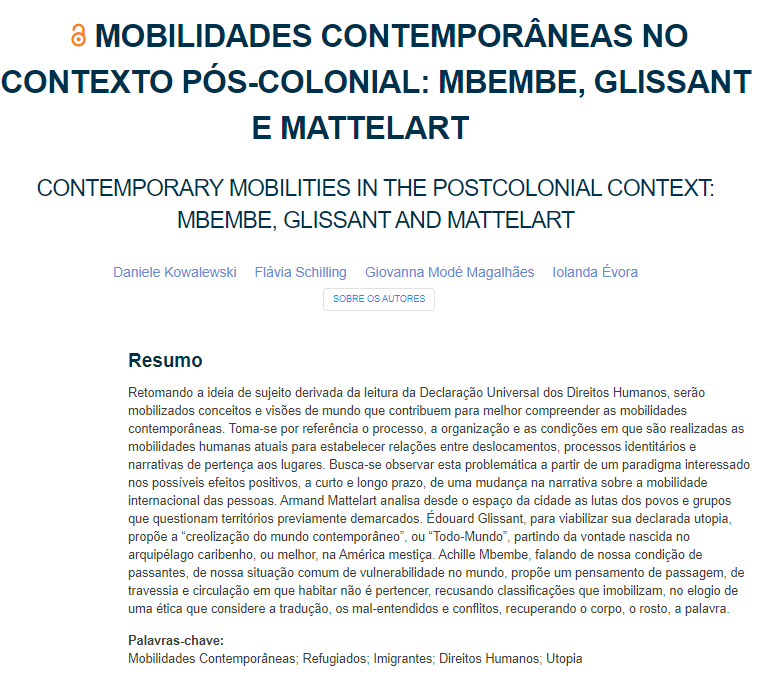
Mobilidades Contemporâneas no Contexto Pós-Colonial: Mbembe, Glissant e Mattelart
Abstract:
Taking up again the idea of subject derived from the reading of the Universal Declaration of Human Rights, concepts and worldviews will be mobilized that contribute to better understand contemporary mobilities. Reference is made to the process, the organization and the conditions in which current human mobilities are carried out to establish relationships between displacement, identity processes and narratives of belonging to places. In Mobilidades Contemporâneas no Contexto Pós-Colonial: Mbembe, Glissant e Mattelart we seek to observe this problematic from a paradigm interested in the possible positive effects, in the short and long term, of a change in the narrative on the international mobility of people. Armand Mattelart analyses, from the space of the city, the struggles of peoples and groups that question previously demarcated territories. To make his declared utopia viable, Édouard Glissant proposes the “creolisation of the contemporary world”, or the “All-World”, starting from the will born in the Caribbean archipelago, or rather, in mestizo America. Achille Mbembe, speaking of our condition of passers-by, of our common situation of vulnerability in the world, proposes a thought of passage, of crossing and circulation in which to inhabit is not to belong, refusing classifications that immobilise, in praise of an ethic that considers translation, misunderstandings and conflicts, recovering the body, the face, the word.
Quotation:
“Kowalewski, Daniele, Schilling, Flávia, Magalhães, Giovanna Modé, & Évora, Iolanda. (2019). Mobilidades Contemporâneas no Contexto Pós-Colonial: Mbembe, Glissant e Mattelart. Lua Nova: Revista de Cultura e Política, (108), 137-156. Epub November 28, 2019. https://doi.org/10.1590/0102-137156/108“
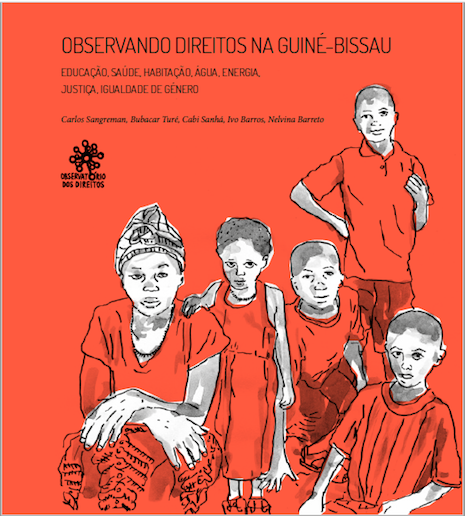
Observando direitos na Guiné-Bissau: educação, saúde, habitação, água, energia, justiça, igualdade de género
The Rights Observatory integrated in a structure such as Casa dos Direitos is an example of what civil society can do in fragile social contexts, but where power respects the Right to Opinion (even if at some times there is repression of media outlets such as radios and television and a climate of threat to critics of the situation at the time). The data collected on access to Economic and Social Human Rights, disseminated through books and exhibitions, in order to be used by activists and responsible authorities, has even been the basis for academic research at undergraduate, master’s and, this year, doctoral levels, especially in Portugal and Brazil.
Abstract:
The objective of Observando direitos na Guiné-Bissau: educação, saúde, habitação, água, energia, justiça, igualdade de género and the Observatório dos Direitos in 2019 was to continue the collection of data on access to Economic and Social Human Rights in Guinea-Bissau with data comparable to those of 2016, and to include two innovations: a new chapter on Women’s Rights or Equality of Gender and perform data collection also in the Bolama/ Bijagós region.
Quotation:
Sangreman, Carlos [et al.] (2020). Observando direitos na Guiné-Bissau : educação, saúde, habitação, água, energia, justiça, igualdade de género. Lisboa: ACEP, com LGDH e CEsA. URL: https://www.repository.utl.pt/handle/10400.5/20866
Access the article here.
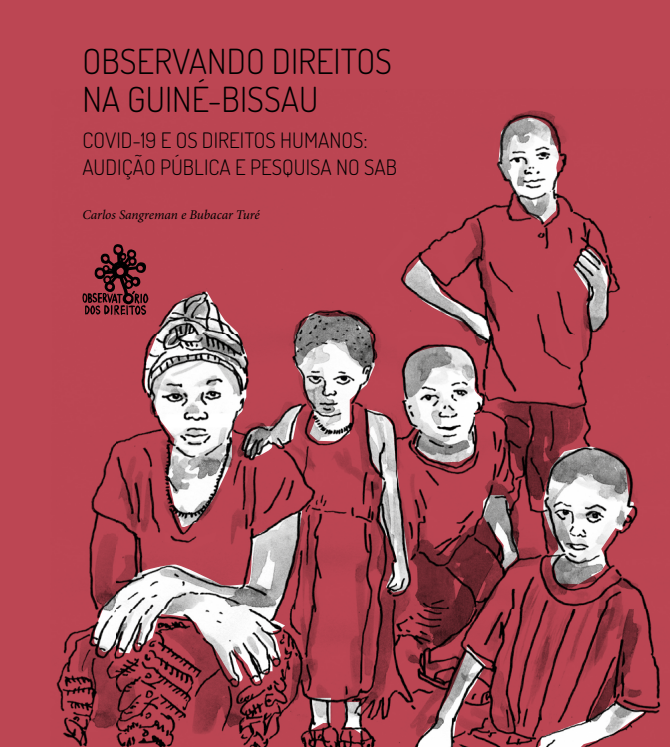
Observando direitos na Guiné-Bissau: Covid-19 e os direitos humanos: audição pública e pesquisa no SAB
Abstract:
Observando Direitos na Guiné-Bissau – Covid-19 e os Direitos Humanos: audição pública e pesquisa no SAB intends to investigate the human rights situation during the Covid-19 pandemic in Guiné-Bissau between January 2020 and January 2022. The framework is based on documentary research on human rights in sub-Saharan Africa from the production of international and specialized organizations, and other non-governmental human rights defenders of the same period. For Guiné-Bissau, in addition to equal research, the communiqués and official bulletins of the “Hight commissariat for Covid-19” were also collected with the information of infected, hospitalized, recovered, deaths and vaccinations, as well as interviews with the newspapers of the Commissioner and the Secretary. With the concentration of cases in the capital, Bissau, the research organize a survey of families, of market sellers and of companies on the effects of the pandemic and the measures enacted by the Government/Presidency to contain. A public hearing was also organized in the House of Rights, with various entities ranging from the High Commissariat to Unions, journalists, and public order police to information about how each institution through its situation and action in this period. As conclusions of the analyses of all these qualitative and quantitative data, it is possible to affirm that Guinea-Bissau’s fragility has such a weight in Guinean society that a disease that has killed fewer people in the country than malaria, diarrhea or tuberculosis has not overlapped with problems arising in poverty and low incomes in general. It affected Human Rights by showing that it was already knew about the enormous shortcomings of the health system, but the effects were more graves on economic and social rights by the abrupt stagnation of economic international activity, the cooperation project, unemployment, and the rise of poverty than directly by the pandemic and measures adopted. The human rights of first generation, more political, freedom of the press and demonstration were affected, with arbitrary arrests and violence practiced by unidentified individuals intensifying the climate of impunity and feeling that the regime is becoming increasingly repressive, but it cannot be said that they were effects directly arising from the pandemic.
Quotation:
Sangreman, C., Turé, B. (2022). Observando Direitos na Guiné-Bissau – Covid-19 e os Direitos Humanos: audição pública e pesquisa no SAB. pag.93. Lisboa: ACEP, com LGDH e CEsA. ISBN 978-9898625-27-4