Human Rights
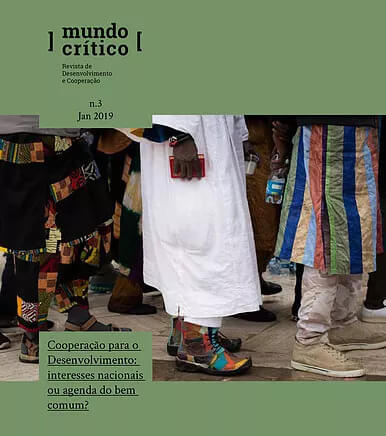
Mundo Crítico n.º 3: Cooperação para o Desenvolvimento: interesses nacionais ou agenda do bem comum?
Abstract:
This third edition of Mundo Crítico explores some of the pressing questions facing development cooperation today, both internationally and nationally. It aims to contribute to a diverse and multi-voiced portrait of a reality undergoing significant changes — conceptually, politically, and in practice — changes that may even challenge the very notion of cooperation as a core value in relations between geographic, political, and cultural spaces. The reasons behind the current turbulent times clearly extend beyond development cooperation itself, but the failure of certain models, or the inadequacy of others, in addressing contemporary challenges has led to their reevaluation within the broader scope of foreign policies in various states. This edition seeks to look to the future, contributing not only to a forward-looking reflection but also to a debate on the current state of Development Cooperation. It questions models, strategies, and narratives, aiming for political choices that we, as a society, can collectively identify with.
The issue begins with an “imperfect conversation”, adopting a critical tone, about the current trends in Development Cooperation and the pressing need to build sustainable local capacities. The “Knowledge and Circumstances” dossier opens with Six Questions on Portuguese Cooperation, a reflection by the Editorial Board aimed at fostering the necessary (and urgent) debate within the sector. The section features articles on diverse perspectives and approaches, including those of countries like China and Norway, recent decisions by Portuguese Cooperation regarding Official Development Assistance, and a reflection on the professionals of the “development industry,” the non-governmental sector in the PALOP countries, and the changes and actions of NGOs in Angola. Additionally, the issue includes an article on women in comics, opening pathways for cooperation and solidarity.
The “Ways of Seeing” section focuses on migration to Europe through the lens of Italian photographer Mario Badagliacca, showcasing objects brought by migrants landing in Lampedusa. The Narratives section presents two journalistic works: one on the Jamaica neighborhood in Portugal and another on a reunion in Ethiopia following the peace agreement with Eritrea.
We revisit the “Innovations” section (introduced in the first issue), with examples of processes promoting human rights in Guinea-Bissau and within the CPLP, as well as cooperation in education between Portugal and Mozambique. The edition concludes with “Ecos Gráficos”, featuring comics, and a curated selection of reading suggestions in Escaparate focused on the current state of Development Cooperation.
Cite this Journal:
ACEP & CEsA (2019). “Cooperação para o Desenvolvimento: interesses nacionais ou agenda do bem comum?”. ISEG/CEsA – Centro de Estudos sobre África e Desenvolvimento. Revista Mundo Crítico nº 3 (Jan 2019). ISSN 2184-1926.
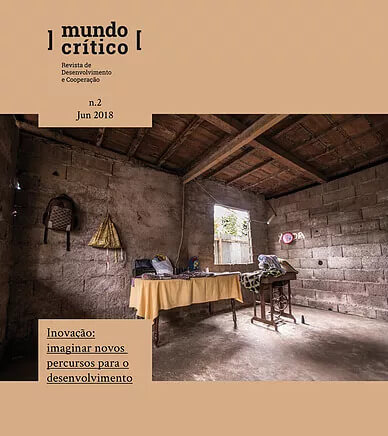
Mundo Crítico n.º 2: Inovação: imaginar novos percursos para o desenvolvimento
Abstract:
What is “new” in “innovation and development”? This question served as the starting point for the challenge we posed in this second edition of Mundo Crítico, aiming to intersect diverse practices, experiences, and perspectives on the “innovation” agenda within international development cooperation.
Perhaps the greatest potential of the international “innovation and development” agenda lies in questioning the dichotomous logics that permeate relationships between “developed countries” and “developing countries.” These dynamics often conceive the former as spaces of “invention, recreation, or renewal” of theories, technologies, or organizational models, and the latter as mere recipients, importing products, values, and ideas. In light of the transformations in the world we live in and the uncertainties surrounding its direction and impacts, it becomes imperative to question what is truly “new” in “innovation and development”—recovering memory, observing the present, and daring to glimpse the future.
This edition begins with an “Imperfect Conversation” about the various dimensions of innovation, which go far beyond mere technological aspects. Social innovation must be accompanied by organizational innovation, fostering a process-oriented approach for truly inclusive and change-oriented development. In the dossier of “Knowledge and Circumstances”, reflective articles explore experiences and practices of innovation for development, including initiatives in creative economies in countries like Cape Verde, Guinea-Bissau, and São Tomé and Príncipe; cash transfers in humanitarian aid contexts; and a project to improve the quality of education in Latin America through school lighting, to name just a few examples. The “Ways of Seeing” section features a photographic dossier showcasing the faces of women from São Tomé and Príncipe, resulting from a project affirming the rights of Santomean women. The “Narratives” section presents practical cases and protagonists who leverage innovation and creativity to tackle diverse challenges.
Finally, we introduce a new section — Ecos Gráficos — dedicated to comics, as well as Escaparate, which serves as a gateway to further readings.
Cite this Journal:
ACEP & CEsA (2018). “Inovação: imaginar novos percursos para o desenvolvimento”. ISEG/CEsA – Centro de Estudos sobre África e Desenvolvimento. Revista Mundo Crítico nº 2 (Jun 2018). ISSN 2184-1926.
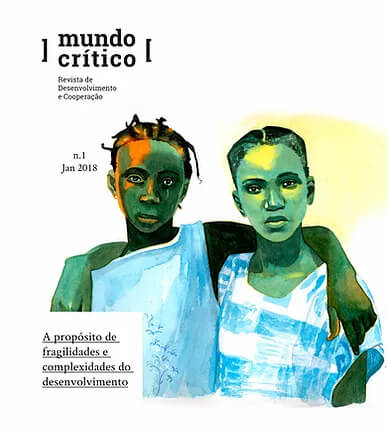
Mundo Crítico n.º 1: A propósito de fragilidades e complexidades do desenvolvimento
Abstract:
In an era of multiple challenges, spanning from the local to the global scale, Mundo Crítico – Journal of Development and Cooperation seeks to address the need for debate among public and private social actors, regardless of their size or geographic and thematic scope, with a critical, persistent, and dialogical commitment. It aims to foster unlikely dialogues between text and image, between art and science, between academics, artists, and practitioners, and among Portuguese-speaking individuals from diverse geographical and cultural spaces. The debate aspires to be comprehensive, with a particular focus on the ongoing social, economic, and political transformations shaping the world we inhabit.
The guiding principle of this platform is rooted in a vision of development as a multidisciplinary social action and the complementarity of various actors, both individual and collective. It considers cooperation among peoples as one of the pillars upon which a shared vision of human rights, well-being, and progress for humanity—both today and for future generations—can be built. A journal of critical thinking to reflect and act.
Cite this Journal:
ACEP & CEsA (2018). “A propósito de fragilidades e complexidades do desenvolvimento”. ISEG/CEsA – Centro de Estudos sobre África e Desenvolvimento. Revista Mundo Crítico nº 1 (Jan 2018). ISSN 2184-1926.
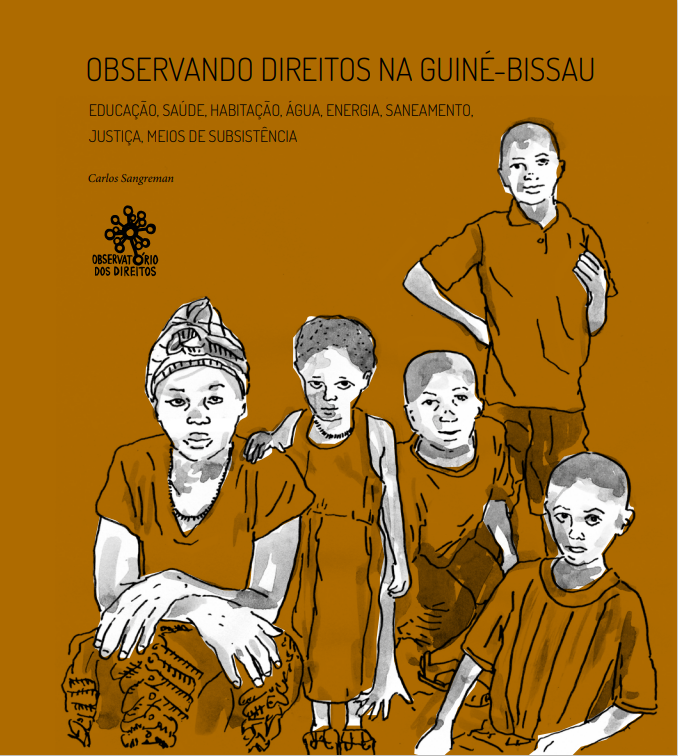
Observando Direitos na Guiné-Bissau: Educação, saúde, habitação, água, energia, saneamento, justiça, meios de subsistência
Quotation:
Sangreman, C. (2017). Observando Direitos na Guiné-Bissau – educação, saúde, habitação, água, energia, saneamento, justiça, meios de subsistência. Lisboa: ACEP, com LGDH e CEsA. ISBN 978-989-8625-16-8

Observando Direitos na Guiné-Bissau: Educação, saúde, habitação, água, energia, saneamento, justiça, meios de subsistência
Quotation:
Sangreman, C. (2016). Observando Direitos na Guiné-Bissau – educação, saúde, habitação, água, energia, saneamento, justiça, meios de subsistência. Lisboa: ACEP, com LGDH e CEsA. ISBN 978-989-8625-14-4
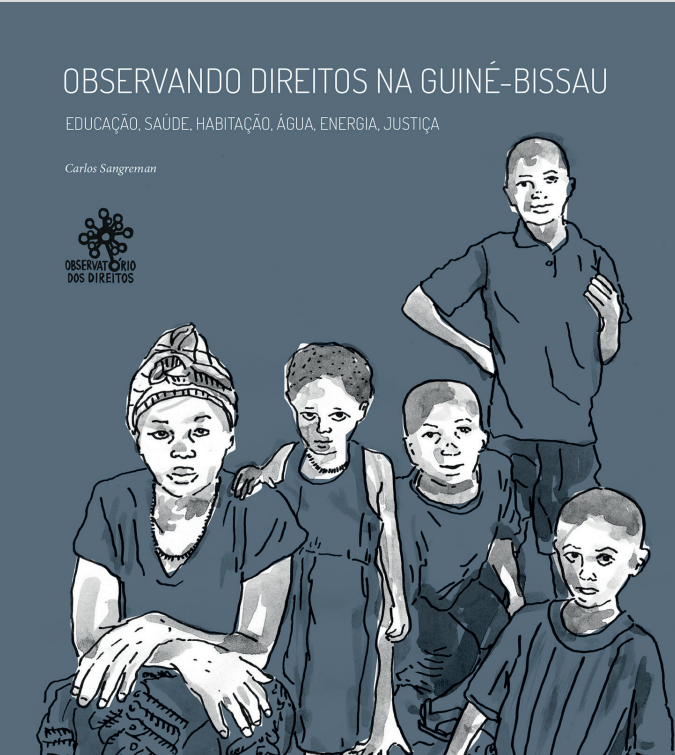
Observando Direitos na Guiné-Bissau: Educação, saúde, habitação, água, energia, justiça
Quotation:
Sangreman, C. (2015). Observando Direitos na Guiné-Bissau – educação, saúde, habitação, água, energia, justiça. Lisboa: ACEP, com LGDH e CEsA. ISBN 978-989-8625-07-6.
Qualidade da Justiça na Guiné-Bissau. Avaliação e recomendações.
Abstract:
The debate on justice is fundamental to understanding the conditions for the realisation of fundamental rights. The reflection on justice and human rights in Guinea-Bissau, which permeates the project “Cooperation in the Promotion of Human Rights: the case of Justice in Guinea-Bissau in the Rights Observatory”, promoted by ACEP and CEsA and funded by Camões-ICL, is part of the work of both organisations with the Guinean League of Human Rights in the Rights Observatory. Since 2015, this Observatory has been collecting and analysing data, throughout the territory of Guinea-Bissau, on the realisation of social and economic rights, and the reflection on justice represents a contribution to stimulating debate and knowledge on one of the most important monitoring areas for the country’s development. Furthermore, ACEP participated, as an associated organisation, in a project of the Guinean Human Rights League on impunity in Guinea-Bissau, and researchers from CEsA have carried out research and published articles on justice, the State and international cooperation in this country. Qualidade da Justiça na Guiné-Bissau. Avaliação e recomendações was prepared based on the ideas and preparatory texts of a report for UNDP in 2015 on the quality of justice in Guinea-Bissau. This update sought, through some fieldwork with magistrates and judicial officials, to understand whether or not the instability that the country experienced between 2015 and 2019 allowed for some improvements in the quality of justice in Guinea-Bissau. It also included data collected by projects after 2015 on the population’s relationship with justice in general. At the same time, the option of not dealing with traditional justice was maintained, focusing only on the state justice system.
Quotation:
Sangreman, Carlos e Luis Vaz Martins (2019). “Qualidade da Justiça na Guiné-Bissau. Avaliação e recomendações”.In Justiça e direitos humanos na Guiné-Bissau, Debates e Perspetivas. ISBN 978-989-8625-18-2, 2019, ACEP e CESA, Lisboa.
Acesso a Justiça, Direitos e Prisões na Guiné – Bissau. Dados e Perceções 2010-2018
Abstract:
The debate on justice is fundamental to understanding the conditions for the realisation of fundamental rights. The reflection on justice and human rights in Guinea-Bissau, which permeates the project “Cooperation in the Promotion of Human Rights: the case of Justice in Guinea-Bissau in the Rights Observatory”, promoted by ACEP and CEsA and funded by Camões-ICL, is part of the work of both organisations with the Guinean League of Human Rights in the Rights Observatory. Since 2015, this Observatory has been collecting and analysing data, throughout the territory of Guinea-Bissau, on the realisation of social and economic rights, and the reflection on justice represents a contribution to stimulating debate and knowledge on one of the most important monitoring areas for the country’s development. Furthermore, ACEP participated, as an associated organisation, in a project of the Guinean Human Rights League on impunity in Guinea-Bissau, and researchers from CEsA have carried out research and published articles on justice, the state and international cooperation in this country. Acesso a Justiça, Direitos e Prisões na Guiné – Bissau. Dados e Perceções 2010-2018 aims to contribute to the understanding of the evolution of access to justice by the population in Guinea-Bissau over the last 18 years of the 21st century, based on existing documents, data collected by the Observatory of Rights, the Justice Support Centres (CAJ) and surveys, projects and studies that collect data on this theme even though it is not their main focus.
Quotation:
Sangreman, Carlos, Bubacar Turé e Rita Cavaco (2019). “Acesso a Justiça, Direitos e Prisões na Guiné – Bissau. Dados e Perceções 2010-2018”.in Justiça e direitos humanos na Guiné-Bissau, Debates e Perspetivas. ISBN 978-989-8625-18-2, 2019, ACEP e CESA, Lisboa.
COVID-19 and Human Rights in a Fragile State: Guinea-Bissau
Abstract:
COVID-19 and Human Rights in a Fragile State: Guinea-Bissau aims to study the situation of Human Rights during the Covid-19 pandemic in Guinea-Bissau, between January 2020 and January 2022. The research organized an inquiry to families, another to companies and another to market/street sellers about the effects of the pandemic and the measures enacted by the Government and Presidency to contain it. A public hearing was also organized, with various entities from the High Commissioner to trade unions, journalists, students, women associations, and the Public Order Police, for information on how each institution saw its situation and action in this period. The conclusions of the analysis of all these qualitative and quantitative data allow us to affirm a) the social actors agreed with the main measures the authorities took to contain the disease; b) the must referred complaint was the lack of any support from the authorities to households, companies and sellers: c) the fragility of Guinea-Bissau has such a social weight that a disease that killed fewer people than malaria, diarrhea, or tuberculosis, did not overcome the problems of human rights stemming from poverty, institutional fragility, and low incomes in general.
Quotation:
Sangreman, C., Faria, R. T., & Turé, B. (2022). COVID-19 and Human Rights in a Fragile State: Guinea-Bissau. In P. Andrade, & M. Martins (Ed.), Handbook of Research on Urban Tourism, Viral Society, and the Impact of the COVID-19 Pandemic (pp. 341-360). IGI Global. https://doi.org/10.4018/978-1-6684-3369-0.ch018
Covid-19 and Human Rights in a fragile state : Guinea-Bissau
Abstract:
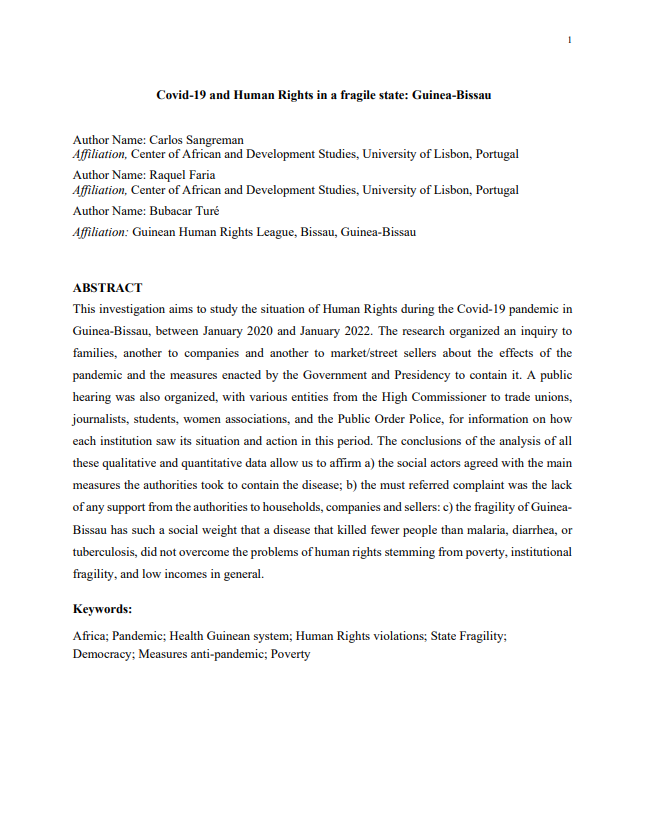
COVID-19 and Human Rights in a Fragile State: Guinea-Bissau aims to study the situation of Human Rights during the Covid-19 pandemic in Guinea-Bissau, between January 2020 and January 2022. The research organized an inquiry to families, another to companies and another to market/street sellers about the effects of the pandemic and the measures enacted by the Government and Presidency to contain it. A public hearing was also organized, with various entities from the High Commissioner to trade unions, journalists, students, women associations, and the Public Order Police, for information on how each institution saw its situation and action in this period. The conclusions of the analysis of all these qualitative and quantitative data allow us to affirm a) the social actors agreed with the main measures the authorities took to contain the disease; b) the must referred complaint was the lack of any support from the authorities to households, companies and sellers: c) the fragility of Guinea-Bissau has such a social weight that a disease that killed fewer people than malaria, diarrhea, or tuberculosis, did not overcome the problems of human rights stemming from poverty, institutional fragility, and low incomes in general.
Quotation:
Sangreman, C., Faria, R. T., & Turé, B. (2022). COVID-19 and Human Rights in a Fragile State: Guinea-Bissau. In P. Andrade, & M. Martins (Ed.), Handbook of Research on Urban Tourism, Viral Society, and the Impact of the COVID-19 Pandemic (pp. 341-360). IGI Global. https://doi.org/10.4018/978-1-6684-3369-0.ch018