Fragile States
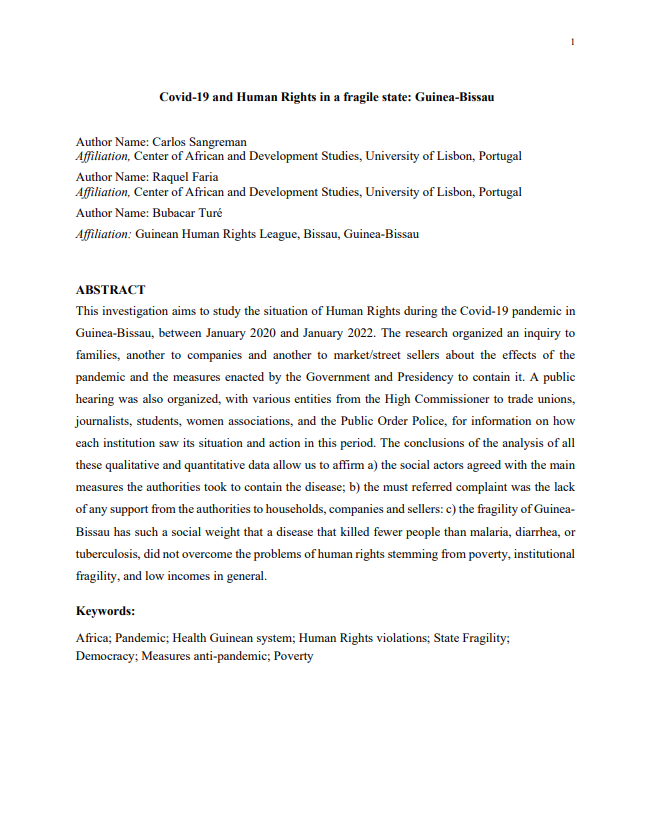
COVID-19 and Human Rights in a Fragile State: Guinea-Bissau
Abstract:
COVID-19 and Human Rights in a Fragile State: Guinea-Bissau aims to study the situation of Human Rights during the Covid-19 pandemic in Guinea-Bissau, between January 2020 and January 2022. The research organized an inquiry to families, another to companies and another to market/street sellers about the effects of the pandemic and the measures enacted by the Government and Presidency to contain it. A public hearing was also organized, with various entities from the High Commissioner to trade unions, journalists, students, women associations, and the Public Order Police, for information on how each institution saw its situation and action in this period. The conclusions of the analysis of all these qualitative and quantitative data allow us to affirm a) the social actors agreed with the main measures the authorities took to contain the disease; b) the must referred complaint was the lack of any support from the authorities to households, companies and sellers: c) the fragility of Guinea-Bissau has such a social weight that a disease that killed fewer people than malaria, diarrhea, or tuberculosis, did not overcome the problems of human rights stemming from poverty, institutional fragility, and low incomes in general.
Quotation:
Sangreman, C., Faria, R. T., & Turé, B. (2022). COVID-19 and Human Rights in a Fragile State: Guinea-Bissau. In P. Andrade, & M. Martins (Ed.), Handbook of Research on Urban Tourism, Viral Society, and the Impact of the COVID-19 Pandemic (pp. 341-360). IGI Global. https://doi.org/10.4018/978-1-6684-3369-0.ch018
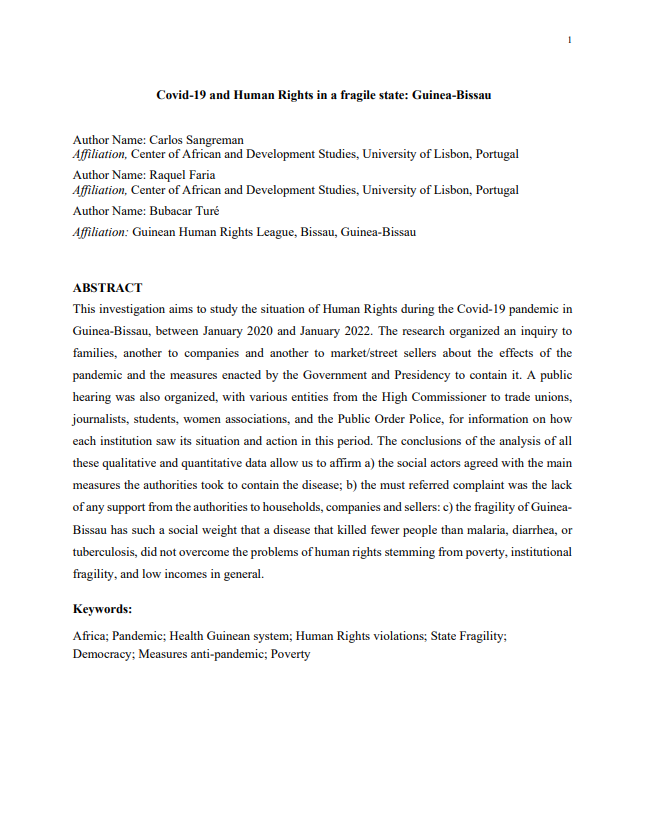
Covid-19 and Human Rights in a fragile state : Guinea-Bissau
Abstract:
COVID-19 and Human Rights in a Fragile State: Guinea-Bissau aims to study the situation of Human Rights during the Covid-19 pandemic in Guinea-Bissau, between January 2020 and January 2022. The research organized an inquiry to families, another to companies and another to market/street sellers about the effects of the pandemic and the measures enacted by the Government and Presidency to contain it. A public hearing was also organized, with various entities from the High Commissioner to trade unions, journalists, students, women associations, and the Public Order Police, for information on how each institution saw its situation and action in this period. The conclusions of the analysis of all these qualitative and quantitative data allow us to affirm a) the social actors agreed with the main measures the authorities took to contain the disease; b) the must referred complaint was the lack of any support from the authorities to households, companies and sellers: c) the fragility of Guinea-Bissau has such a social weight that a disease that killed fewer people than malaria, diarrhea, or tuberculosis, did not overcome the problems of human rights stemming from poverty, institutional fragility, and low incomes in general.
Quotation:
Sangreman, C., Faria, R. T., & Turé, B. (2022). COVID-19 and Human Rights in a Fragile State: Guinea-Bissau. In P. Andrade, & M. Martins (Ed.), Handbook of Research on Urban Tourism, Viral Society, and the Impact of the COVID-19 Pandemic (pp. 341-360). IGI Global. https://doi.org/10.4018/978-1-6684-3369-0.ch018
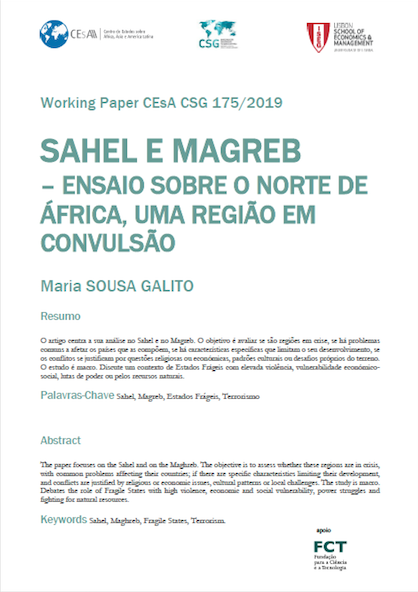
Working Paper 175/2019: Sahel e Magreb: Ensaio sobre o Norte de África, uma região em convulsão
Abstract:
Sahel e Magreb : ensaio sobre o norte de África, uma região em convulsão focuses on the Sahel and on the Maghreb. The objective is to assess whether these regions are in crisis, with common problems affecting their countries; if there are specific characteristics limiting their development, and conflicts are justified by religious or economic issues, cultural patterns or local challenges. The study is macro. Debates the role of Fragile States with high violence, economic and social vulnerability, power struggles and fighting for natural resources. The paper is subdivided into two chapters. The first compares the Sahel and Maghreb regions, with a short analysis for each country that constitutes them, since the spaces are very related to each other, since traffickers transit along the trade routes of the ancient caravans of the desert caravans, or less watched over by law enforcement agents or controlled by guerrillas or or controlled by guerrilla or terrorist groups. Maps and statistical tables are offered for appropriate comparisons. The second chapter is about the influence of the Arab Spring in North Africa, with reference its main causes and consequences. Given that these states are considered fragile by the international community, the question is whether they are failures and why they have serious problems of governance, internal stability or the stability of their borders. It assesses the fight against terrorism, in a sensitive in a sensitive context where former guerrilla fighters are still active, part of militias or terrorist groups or claiming possession of natural resources, reclaiming for themselves the sources of income and the channels of distribution. sources of income and channels of distribution. Different types of violence or organised crime are also differentiated crimes.
Quotation:
Galito, Maria Sousa (2019). “Sahel e Magreb : ensaio sobre o norte de África, uma região em convulsão”. Instituto Superior de Economia e Gestão – CEsA/ CSG – Documentos de Trabalho nº 175/2019.