Uncategorized

THE ABCs OF COOPERATION AT THE UNIVERSITY OF AVEIRO
UA Library – Hélène de Beauvoir Room – February 12–27
The Alphabet of Cooperation – Concepts, Stories, Images is a collective work that invites critical reflection on current issues related to development cooperation. Bringing together contributions from academics, journalists, activists, development cooperation professionals, and visual artists (ranging from photography to illustration), the catalog/exhibition weaves together diverse reflections and experiences, giving voice to the variety of perspectives, practices, and debates shaping development cooperation today.
Following its presentation in Lisbon, *The Alphabet of Cooperation: Concepts, Stories, Images* continues its tour across the country, with its first stop at the University of Aveiro. The exhibition, which brings together texts and images exploring concepts related to International Development Cooperation, is on display at the University of Aveiro Libraries, in the Hélène de Beauvoir Room, through February 27.
Opening | Roundtable Discussion: February 19, at 5:30 p.m.
The exhibition will open, followed by a roundtable discussion, and will serve as an opportunity to debate the role and challenges of Portuguese development cooperation.


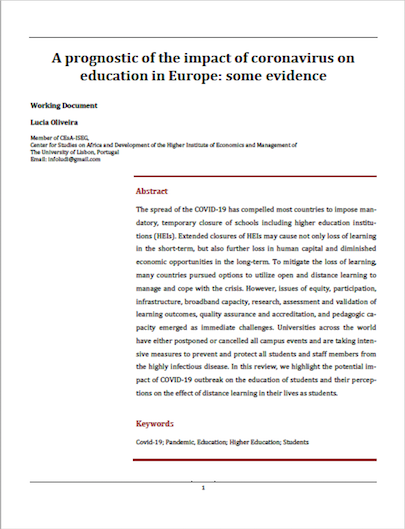
A prognostic of the impact of coronavirus on education in Europe: some evidence
In A prognostic of the impact of coronavirus on education in Europe: some evidence, Lúcia Oliveira highlights the impact of the COVID-19 outbreak on student education and their perceptions corcerning the effect of distance learning on their lives as students. Thus, we conducted a survey to university students in Portugal, during the month of July, who composed a sample of convenience due to time constraints and at the end of the school year, which made the collection of information extremely important to evaluate the real impact at that very moment, taking also into account other external factors. We found out that students live difficult moments at the educational and private level due to the complex professional situation of their parents. All of these factors have a major impact in terms of mental health, as many of them reported experiencing anxiety and stress.
Abstract:
The spread of COVID-19 forced most countries to temporarily close educational institutions. It may cause not only short-term learning loss, but also an additional loss of human capital and reduced long-term economic opportunities. To mitigate this loss, many countries have opted for distance learning. However, issues of equity, participation and evaluation of results emerged as challenges. Universities have postponed or cancelled classes and are taking measures to protect all students and staff from highly infectious diseases. In this study, we highlight the impact of the COVID-19 outbreak on student education and their perceptions corcerning the effect of distance learning on their lives as students. Thus, we conducted a survey to university students in Portugal, during the month of July, who composed a sample of convenience due to time constraints and at the end of the school year, which made the collection of information extremely important to evaluate the real impact at that very moment, taking also into account other external factors. Given the exploratory nature of this empirical research, data analysis is descriptive, measuring opinions, attitudes and perceptions that students have about the impact of the pandemic on their educational path. We found out that students live difficult moments at the educational and private level due to the complex professional situation of their parents. All of these factors have a major impact in terms of mental health, as many of them reported experiencing anxiety and stress. It will be a challenge for universities to deal with this new reality, to prepare an uncertain future not only for students, but also for professionals, who will need more preparation and training to face the new teaching methodologies.
Quotation:
“A prognostic of the impact of coronavirus on education in Europe: some evidence.” 4. International Seminar. Education, Territories and Human Development. Catolica, Faculty of Education and Psychology, Porto. pp. 550-557 https://www.fep.porto.ucp.pt/sites/default/files/files/FEP/eventos/Atas-SIETDH-2021.pdf https://www.repository.utl.pt/handle/10400.5/23273
Access the article here.