Globalisation and Development Cooperation
Working Paper 191/2023: Programas de transferência condicionada de rendimento e a viragem à esquerda na América Latina
Abstract:
In the last three decades, two phenomena have emerged and expanded in waves in Latin America: Conditional Cash Transfer (CCT) programs and the arrival of left-wing governments to power. This scenario is set in a historic period of economic recovery in the Region, especially with the “commodity boom”, providing the resources and political space needed to govern on the left and promote social policies. Transferência condicionada de rendimento e a viragem à esquerda na América Latina works with the research hypothesis that left-wing governments were the ones that most created, supported and expanded this type of public policy in Latin America in the period 2000-2020. Thirthy-two CCTs were mapped, implemented by 18 countries in the Region, as well as their presidents and policy guidelines. In addition to reporting on the evolution of the implementation of these policies, this work carried out a quantitative analysis based on IDB and ECLAC databases about the beginning and end of these programs, as well as the evolution of the coverage of beneficiaries. The main conclusions indicate that the hypothesis is only partially and limitedly confirmed. In short, left-wing governments achieved the highest numbers in absolute terms regarding the creation and expansion of CCTs in the region, but centrist governments achieved the highest rates of new programs and increased coverage (in relative terms) – with subtle differences in outcomes between left-wing and centrist governments. Thus, we conclude that the adoption and expansion of CCTs among Latin American countries in the last two decades was largely independent of the political orientation of the governments considered. It was, above all, a regional stake that crossed ideologies, historical moments and economic crises to redistribute income over the last 20 years to more than 100 million people.
Quotation:
Rios Franco, M. (2023). “Programas de transferência condicionada de rendimento e a viragem à esquerda na América Latina“. Instituto Superior de Economia e Gestão – CEsA/CSG – Documentos de Trabalho nº 191/2023
Working Paper 190/2023: Study of the value chain of the tourism sector in Angola as an alternative economic, social, and environmental development strategy under the Prodesi programme
Abstract:
Angola has been facing several economic and social problems, with one of the most important being related to the country’s long tradition of dependency on oil as a major external revenue. Due to this situation, the country’s income has been slowing and there is a need to find alternative strategies to increase the liquidity of the economy without which Angola would lack the necessary funds to increase investment and proceed with adequate policies to combat social exclusion and eradicate the flows of poverty. Aware of this situation, the government implemented the national PRODESI project, whose aim is to accelerate the process of the diversification of the nation’s economy. To this end, the project aims to promote production and exports in the non-oil sectors, as well as in sectors with a strong potential for import substitution. One of these areas is tourism, as a means of developing some of the country’s regions and provinces, and also in order to benefit populations living in worse conditions, whilst diversifying the economic restrictions. The focus of actions in PRODESI foresees that the to accelerate the diversification of the economy, whether through import substitution or through diversification and an increase in exports, will be directed towards the production of goods and services or the implementation of new strategies designed to gain critical mass and create intra and intersectoral relationships, such as in the case of tourism. Accordingly, the purpose of this research is to identify the main weaknesses of the core value chain of tourism and to propose a set of measures and recommendations to be implemented within the scope of PRODESI. The main objective is to ensure that this activity effectively contributes to diversifying Angola’s economy in a sustainable path and that it helps leverage the increase in national production in a faster and more efficient way and thus significantly help decrease the dependency on imports and increase the export basis, which can be achieved through adopting a strategy of diversification, based on both international and national tourism. 3 Methodologically, several studies were consulted and various meetings and in-depth field visits were made, between January and March 2000, in the provinces of Luanda, Malange, Huíla, and Namibe. Several interviews were carried out up until 2021with major players (ranging from ministers through to national directors and other experts) and tourist organizations (Ministries, Travel Agencies, and entrepreneurs). It is estimated that in the next 10 years Sub-Saharan Africa will register a growth in tourism superior to the global average, regardless of the COVID pandemic. Study of the Value Chain of the Tourism Sector in Angola as an Alternative Economic, Social, and Environmental Development Strategy Under the Prodesi Programme concluded that even though tourism in Angola still faces a deficit at several levels, the country nevertheless has a set of natural resources and tourism attributes that, if properly explored and used, could provide an alternative way for the future development of Angola’s society. Angola still faces residual tourism receipts from tourism activity as well as in total international incoming tourists, and therefore Angola’s national government may have a huge opportunity to implement a suitable tourism strategy (both for internal and external flows), in order to not only reinforce its importance but also to benefit the population, fight poverty, and diversify economic activities, as defined in the PRODESI strategy.
Quotation:
Sarmento, E.M. 2023. “Study of the Value Chain of the Tourism Sector in Angola as an Alternative Economic, Social, and Environmental Development Strategy Under the Prodesi Programme“. Instituto Superior de Economia e Gestão – CEsA/CSG – Documentos de Trabalho nº 190/2023
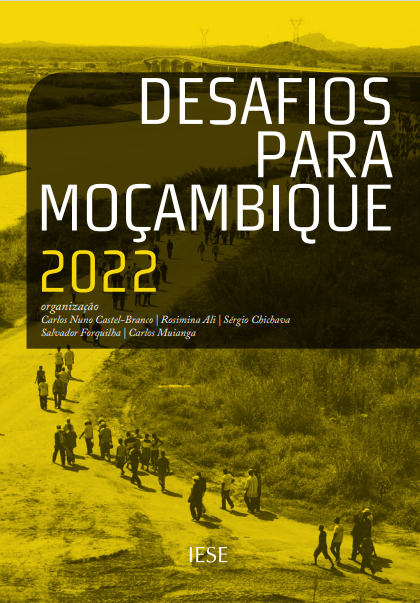
Desafios para Moçambique, 2022
Abstract:
This issue of Desafios para Moçambique (2022) comes as the country faces enormous challenges – the war in Cabo Delgado, with some signs of expansion into other provinces; the Rovuma basin gas extraction and liquefaction projects, which realise some 24 Challenges for Mozambique 2022 Introduction of the greatest challenges in Mozambique’s economic history; the lingering effects of the global crisis, the bursting and implosion of the economic bubble, of which the sovereign debt crisis was a manifestation, and the social and economic after-effects of the covid-19 pandemic. These challenges and crises stimulated research and resulted in lessons, some of which are developed in this issue. Recently ended in Maputo, the trial of some of the state agents and private agents involved in the illicit international financial transactions that resulted in the odious debts. What was already clear before – that these illicit transactions are a reflection of more general dynamics of expropriation, privatisation and financialisation of the state for private accumulation of capital, even if this is done at heavy social costs – has, if possible, become clearer. The hypothesis that the legal process, which we had the opportunity to follow for about a year and a half, only touched on the recipients of commissions for corruption and influence peddling, the executors of the great default against the public purse, was confirmed.
Quotation:
Castel-Branco, C.N., Ali, R., Chichava, S., Forquilha, S., Muianga, C. (2022) Desafios para Moçambique, 2022. IESE. Maputo, Moçambique. ISBN: 978-989-8464-58-3
As Perspetivas de Cooperação Económica entre Portugal e a China
Abstract:
As Perspetivas de Cooperação Económica entre Portugal e a China exposes how Since the state visit of President Xi Jinping to Portugal in December 2018, a framework for diplomatic relations between Portugal and China has been established, with a high level of cooperation in areas such as economy and trade, investment and finance, energy, technology, blue economy, education and culture. Of the 17 cooperation protocols signed then between Portuguese and Chinese governmental and private institutions, one is of particular relevance because it structures in a very significant way the level of cooperation between the two countries and its framework in the new global context. I am referring to the cooperation protocol between the governments of Portugal and China, within the framework of the Silk Road Economic Belt Initiative and the New 21st Century Maritime Silk Road. The presence of Portuguese President Marcelo Rebelo de Sousa at the “Second Belt and Road Forum for International Cooperation”, which was held in Beijing from 25 to 27 April 2019, confirms the importance of the signing of this protocol and the prospects for economic cooperation that it opens, both in bilateral and multilateral relations. According to the signed document, the vision of the multilaterality of this cooperation is expressed with regard to other EU countries but implicit in the relationship with other Portuguese-speaking countries, mostly African developing countries, with the Belt and Road Initiative (IFR) focusing especially on connectivity between countries aimed at sustainable development objectives.
Quotation:
Fernanda Ilhéu (2019), As Perspetivas de Cooperação Económica entre Portugal e a China. O Economista-Anuário da Economia Portuguesa, 32ª Edição, Ordem dos Economistas, ISBN 1646-9909, pp:40-45, Lisboa.
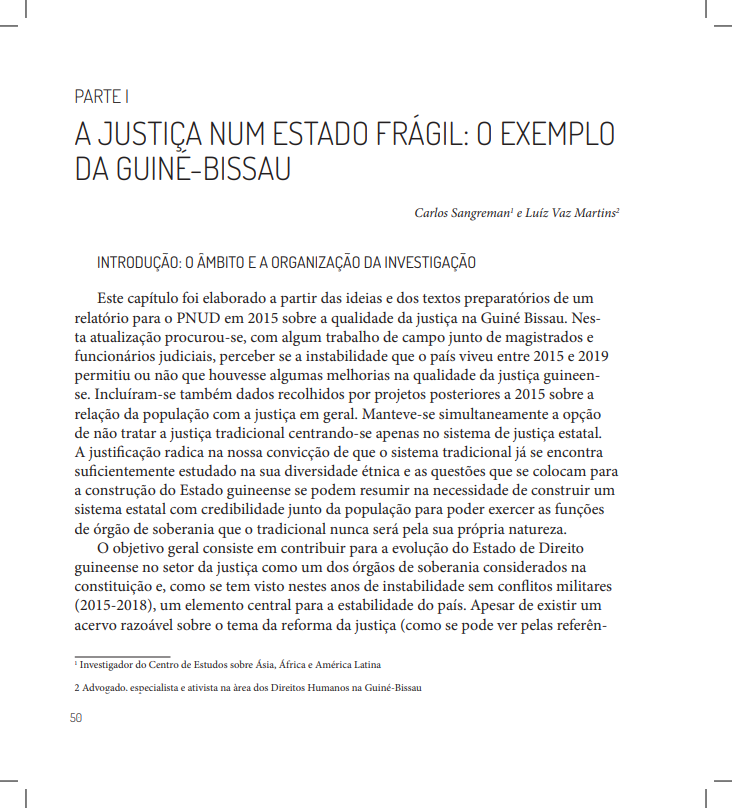
Qualidade da Justiça na Guiné-Bissau. Avaliação e recomendações.
Abstract:
The debate on justice is fundamental to understanding the conditions for the realisation of fundamental rights. The reflection on justice and human rights in Guinea-Bissau, which permeates the project “Cooperation in the Promotion of Human Rights: the case of Justice in Guinea-Bissau in the Rights Observatory”, promoted by ACEP and CEsA and funded by Camões-ICL, is part of the work of both organisations with the Guinean League of Human Rights in the Rights Observatory. Since 2015, this Observatory has been collecting and analysing data, throughout the territory of Guinea-Bissau, on the realisation of social and economic rights, and the reflection on justice represents a contribution to stimulating debate and knowledge on one of the most important monitoring areas for the country’s development. Furthermore, ACEP participated, as an associated organisation, in a project of the Guinean Human Rights League on impunity in Guinea-Bissau, and researchers from CEsA have carried out research and published articles on justice, the State and international cooperation in this country. Qualidade da Justiça na Guiné-Bissau. Avaliação e recomendações was prepared based on the ideas and preparatory texts of a report for UNDP in 2015 on the quality of justice in Guinea-Bissau. This update sought, through some fieldwork with magistrates and judicial officials, to understand whether or not the instability that the country experienced between 2015 and 2019 allowed for some improvements in the quality of justice in Guinea-Bissau. It also included data collected by projects after 2015 on the population’s relationship with justice in general. At the same time, the option of not dealing with traditional justice was maintained, focusing only on the state justice system.
Quotation:
Sangreman, Carlos e Luis Vaz Martins (2019). “Qualidade da Justiça na Guiné-Bissau. Avaliação e recomendações”.In Justiça e direitos humanos na Guiné-Bissau, Debates e Perspetivas. ISBN 978-989-8625-18-2, 2019, ACEP e CESA, Lisboa.
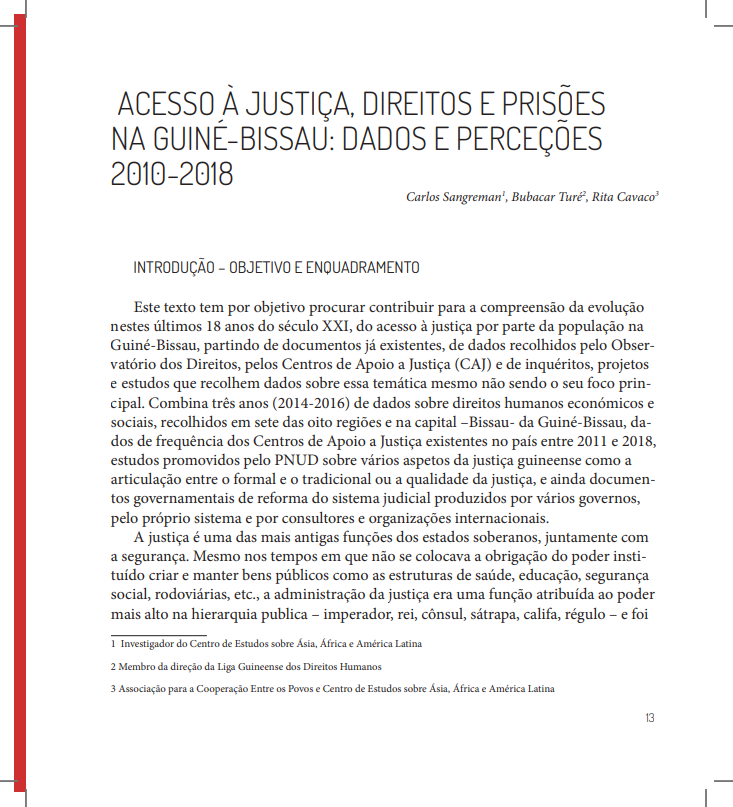
Acesso a Justiça, Direitos e Prisões na Guiné – Bissau. Dados e Perceções 2010-2018
Abstract:
The debate on justice is fundamental to understanding the conditions for the realisation of fundamental rights. The reflection on justice and human rights in Guinea-Bissau, which permeates the project “Cooperation in the Promotion of Human Rights: the case of Justice in Guinea-Bissau in the Rights Observatory”, promoted by ACEP and CEsA and funded by Camões-ICL, is part of the work of both organisations with the Guinean League of Human Rights in the Rights Observatory. Since 2015, this Observatory has been collecting and analysing data, throughout the territory of Guinea-Bissau, on the realisation of social and economic rights, and the reflection on justice represents a contribution to stimulating debate and knowledge on one of the most important monitoring areas for the country’s development. Furthermore, ACEP participated, as an associated organisation, in a project of the Guinean Human Rights League on impunity in Guinea-Bissau, and researchers from CEsA have carried out research and published articles on justice, the state and international cooperation in this country. Acesso a Justiça, Direitos e Prisões na Guiné – Bissau. Dados e Perceções 2010-2018 aims to contribute to the understanding of the evolution of access to justice by the population in Guinea-Bissau over the last 18 years of the 21st century, based on existing documents, data collected by the Observatory of Rights, the Justice Support Centres (CAJ) and surveys, projects and studies that collect data on this theme even though it is not their main focus.
Quotation:
Sangreman, Carlos, Bubacar Turé e Rita Cavaco (2019). “Acesso a Justiça, Direitos e Prisões na Guiné – Bissau. Dados e Perceções 2010-2018”.in Justiça e direitos humanos na Guiné-Bissau, Debates e Perspetivas. ISBN 978-989-8625-18-2, 2019, ACEP e CESA, Lisboa.
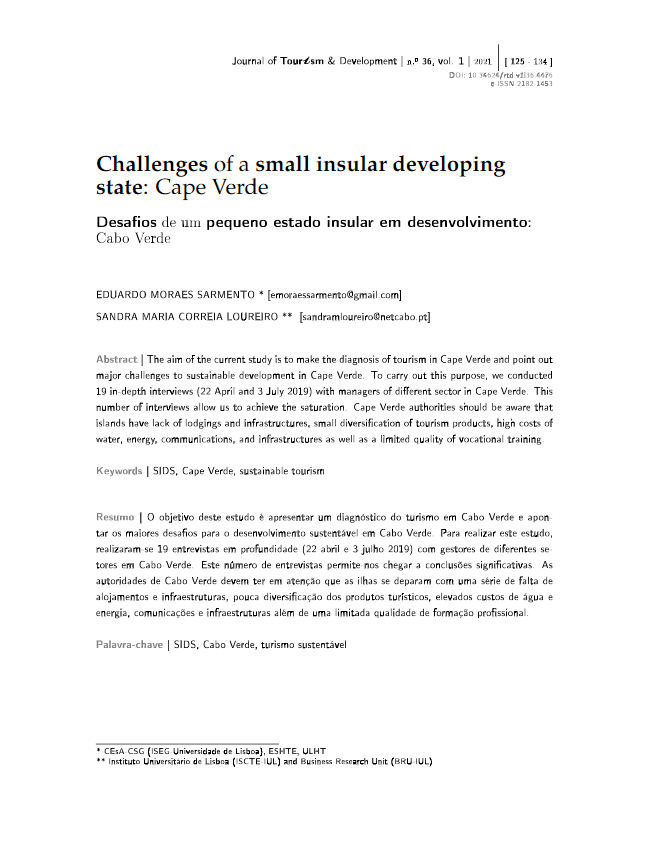
Challenges of a small insular developing state: Cape Verde
Abstract:
The objective of Desafios de um pequeno estado insular em desenvolvimento: Cabo Verde is to present a diagnosis of tourism in Cape Verde and point out the major challenges for sustainable development in Cape Verde. To carry out this study, 19 in-depth interviews (22 April and 3 July 2019) were conducted with managers from different sectors in Cape Verde. This number of interviews allows us to reach significant conclusions. The Cape Verdean authorities must take into account that the islands are faced with a series of shortages of accommodation and infrastructure, little diversification of tourism products, high costs of water and energy, communications and infrastructure in addition to a limited quality of professional training. In order to achieve a hub economy, Cape Verde needs to implement a strong strategy to capture foreign domestic investment (FDI) supported by a strong diplomatic strategy. Like many other SIDS, Cape Verde suffers from an enormous shortage of capital, technology, qualified human resources, high-level organizational capacity, and markets. FDI brings in resources and, in doing so, has direct, indirect, and induced effects on all sectors of economic and social life, as well as the improvement of macroeconomic variables, like GDP, the balance of payments, employment, income and government revenue.
Quotation:
Sarmento, E., & Loureiro, S. M. (2021). Desafios de um pequeno estado insular em desenvolvimento: Cabo Verde. Revista Turismo & Desenvolvimento, 36(1), 125-134. https://doi.org/10.34624/rtd.v1i36.4476
Identifying differences and similarities between donors regarding the long-term allocation of official development assistance
Abstract:
Advanced countries have pledged to mobilize additional financial resources to developing countries, including funding from multiple sources other than official development assistance (ODA), known as foreign aid. However, the effect of the novel coronavirus pandemic has raised doubts about the feasibility of such a pledge, highlighting, once again, the possible role of ODA and the importance of explaining its allocation, which could be of vital relevance for understanding its effectiveness. Identifying differences and similarities between donors regarding the long-term allocation of official development assistance analyzes a vast number of bilateral and multilateral donors by applying a novel methodology in the context of aid allocation – principal-component factor analysis – covering the period 1990–2015. The results revealed four distinct clusters of donors: (i) the proportionally largest Western European donors, characterized by a significant number of beneficiaries, especially low-income countries; (ii) donors that are predominantly driven by structural links with recipients, especially links derived from colonial connections; (iii) a group of mainly Eastern European donors who are engaged with lower-income countries in Eastern Europe and Western Asia; and (iv) a group of Asian and Oceanian donors that select their partners mainly based on the geographical proximity criterion.
Quotation:
Paulo Francisco, Sandrina B. Moreira & Jorge Caiado (2021) Identifying differences and similarities between donors regarding the long-term allocation of official development assistance, Development Studies Research, 8:1, 181-198, DOI: 10.1080/21665095.2021.1954965

State of the Art About COVID-19’s Impact on Santiago University, Cape Verde
Abstract:
The COVID-19 pandemic has become a critical challenge for the higher education sector worldwide. Under such a circumstance, the exploration of the capacity of this sector to adapt to such a state of uncertainty has become of huge importance. In this chapter, State of the art about COVID-19 impact in Santiago University – Cape Verde, the authors critically reflect on the Cape Verdean teaching experience during the early COVID-19 lockdown. This is an exploratory case study based on a qualitative approach with an aim to reflect on new practices of teaching under a pandemic emergency. Based on the teaching experience of teaching in Santiago University, they explain how this university has changed from a face-to-face to an online teaching system and stress the challenges and opportunities that appear from this transition process. This chapter concludes that this strategy has become an opportunity to the university since it consistently raised the number of international students cooperating with them and also that the more adaptive and resilient approaches to online teaching were also a success.
Quotation:
Sarmento, E., Monteiro, J. (2021). Capítulo 16: State of the art about COVID-19 impact in Santiago University – Cape Verde. In Loureiro, Sandra & Guerreiro, João (eds.) Handbook of Research on Developing a Post-Pandemic Paradigm for Virtual Technologies in Higher Education. ISBN13: 9781799869634; ISBN10: 1799869636. IGI Global (Q2, SJR:0,338)
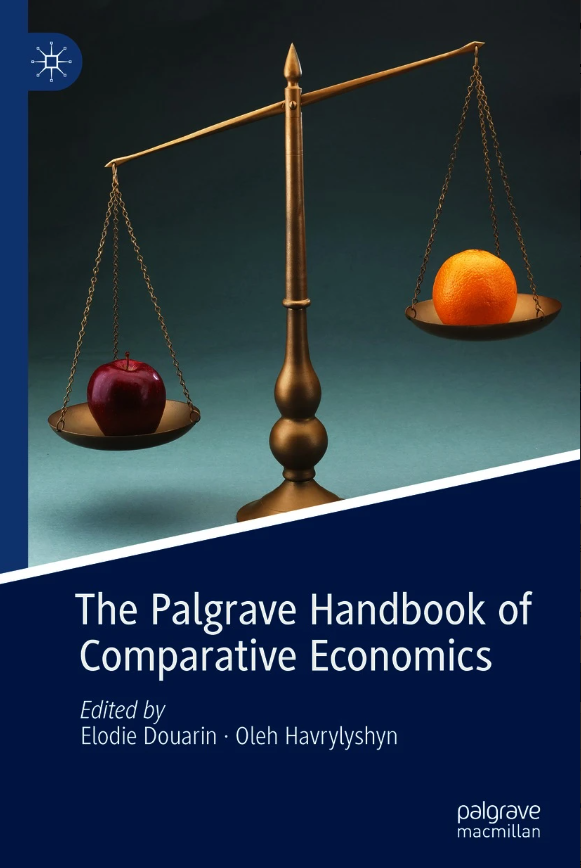
Reform Design Matters: The Role of Structural Policy Complementarities
Abstract:
In this chapter, Reform Design Matters: The Role of Structural Policy Complementarities, we discuss possible interactions across structural policy domains. While relatively more studied in the context of the post-communist transition literature, our survey suggests that relationships of this type hold more generally and can be important to improve our understanding of the relationship between structural reforms and long-run economic growth. Given its potential relevance for the design of successful reform packages, exploring in a more exhaustive way the notion that the effect of a given reform on economic growth depends on the progress made in other policy areas should be a priority point for future research. This may be particularly relevant to help unlock the growth potential of many developing and emerging countries, namely concerning their integration in the global economy. The authors would like to thank Elodie Douarin and Oleh Havrylyshyn for very useful comments on the first draft of this paper. The views expressed in this paper are those of the authors and do not necessarily reflect those of the OECD and its Member countries. Rocha acknowledges financial support from Fundação para a Ciência e Tecnologia (Portugal) through research grant UIDB/05069/2020.
Citação:
Oliveira-Martins, J., da Rocha, B.T. (2021). Reform Design Matters: The Role of Structural Policy Complementarities. In: Douarin, E., Havrylyshyn, O. (eds) The Palgrave Handbook of Comparative Economics. Palgrave Macmillan, Cham. https://doi.org/10.1007/978-3-030-50888-3_19