Other Books
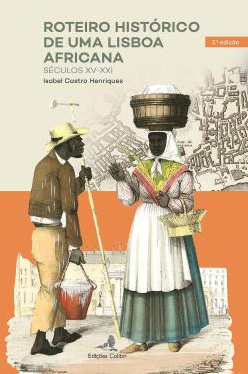
Historical Guide to an African Lisbon
Abstract:
Lisbon, a city of as many valleys and hills as there are myths surrounding its history and the people who invented it, stretches along the Tagus, where the river ends its course through Iberian land and plunges into the Atlantic Ocean. Lisbon was born on the hill of São Jorge Castle, where a Bronze Age settlement left its traces, which crossed with many other marks engraved by Greeks, Phoenicians, Lusitanians, Romans, Visigoths, Arabs, Jews and Christians. A long road of people and cultures, of stories and legends, of gods and heroes who, like Ulysses the mythical founder of the city – Olisipo – which owes its name to him, built and rebuilt this urban space. The aim of Historical Guide to an African Lisbon, XV-XXI Century is to show Lisbon’s Africanness, dispersed in a plurality of memories and immaterial and invisible traces in the days in which we live. History tells us about the settlement and life of thousands of Africans who for centuries took part in the process of building the Portuguese national fact. Travelling through the city, armed with historical knowledge, we are surprised by the vigorous African presence that invaded all spaces of Lisbon society, we reconstruct a hidden Lisbon, submerged by a centuries-old prejudice that still dominates our collective imagination and we understand, with greater clarity, not only behaviours, values, practices that remain in urban daily life, but also the constant reinventions of Portuguese and African identities, present in the country.
Quotation:
Castro Henriques, I. (2021). « Historical Guide to an African Lisbon, XV-XXI Century», versão revista e actualizada, Lisboa, Edições Colibri, 2021.
The Routledge Handbook of EU-Africa Relations
Abstract:
This handbook provides a comprehensive overview of the changing dynamics in the relationship between the African continent and the EU, provided by leading experts in the field. Structured into five parts, the book provides an incisive look at the past, present and potential futures of EU-Africa relations. The cutting-edge chapters cover themes like multilateralism, development assistance, institutions, gender equality and science and technology, among others. Thoroughly researched, this book provides original reflections from a diversity of conceptual and theoretical perspectives, from experts in Africa, Europe and beyond. The handbook thus offers rich and comprehensive analyses of contemporary global politics as manifested in Africa and Europe. This handbook will be an essential reference for scholars, students, researchers, policy makers and practitioners interested and working in a range of fields within the (sub)disciplines of African and EU studies, European politics and international studies. The Routledge Handbook of EU-Africa Relations, by Luís Mah (researcher for the Centre for African and Development Studies), Nial Duggan and Toni Haastrup is part of the mini-series Europe in the World Handbooks examining EU-regional relations and established by Professor Wei Shen.
Quotation:
Mah, Luís, Duggan, Nial & Haastrup, Toni (2021). The Routledge Handbook of EU-Africa Relations. Routledge. ISBN 9781315170916.
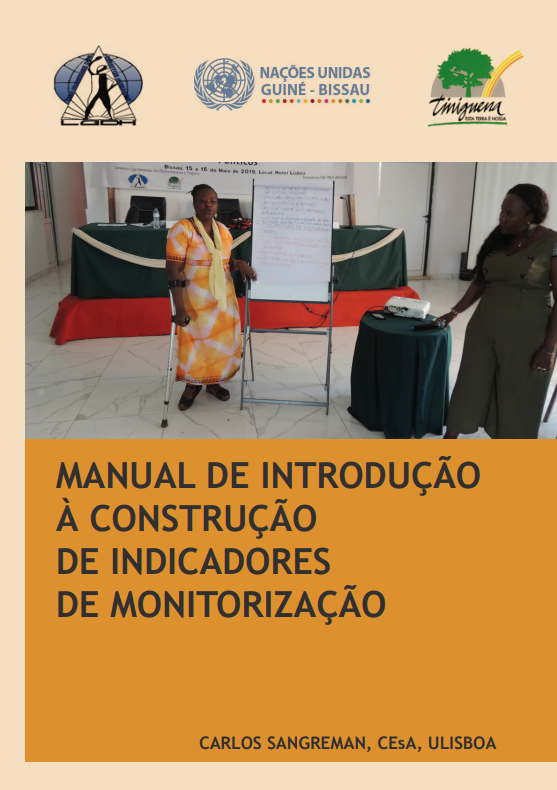
Manual de Introdução à Construção de Indicadores de Monitorização
Abstract:
Manual de Introdução a construção de indicadores de monitorização is a working and training tool for technicians from public and private, national or international institutions working in the area of development and public policies. Its objective is to enable technical experts to develop capacities to think about indicators that are appropriate for projects and policies in their area of intervention. The technical level is introductory to the subject and does not indicators on business management, for example, finance or macroeconomics, and no previous knowledge of mathematics or statistics is required beyond the basics and common sense. It contains chapters with a theoretical part and a practical part, through examples applicable to Guinea-Bissau, on simple and composite, quantitative and qualitative and composite, quantitative and qualitative indicators, short and long term sampling and descriptive statistics. Since this version is prepared for Guinea-Bissau, the last chapter seeks to reflect on the lessons from the lessons learned from the Manual on the construction of indicators which are included in the Political and Social Stability Pact (Pact), signed in 2018, as an example of a multidisciplinary area with fundamental interest for the country.
Quotation:
Sangreman, Carlos (2021). Manual de Introdução a construção de indicadores de monitorização, PNUD/UNIOGBIS, Delegação da Guiné-Bissau, 2020. Liga Guineense dos Direitos Humanos (LGDH) e Tiniguena.